
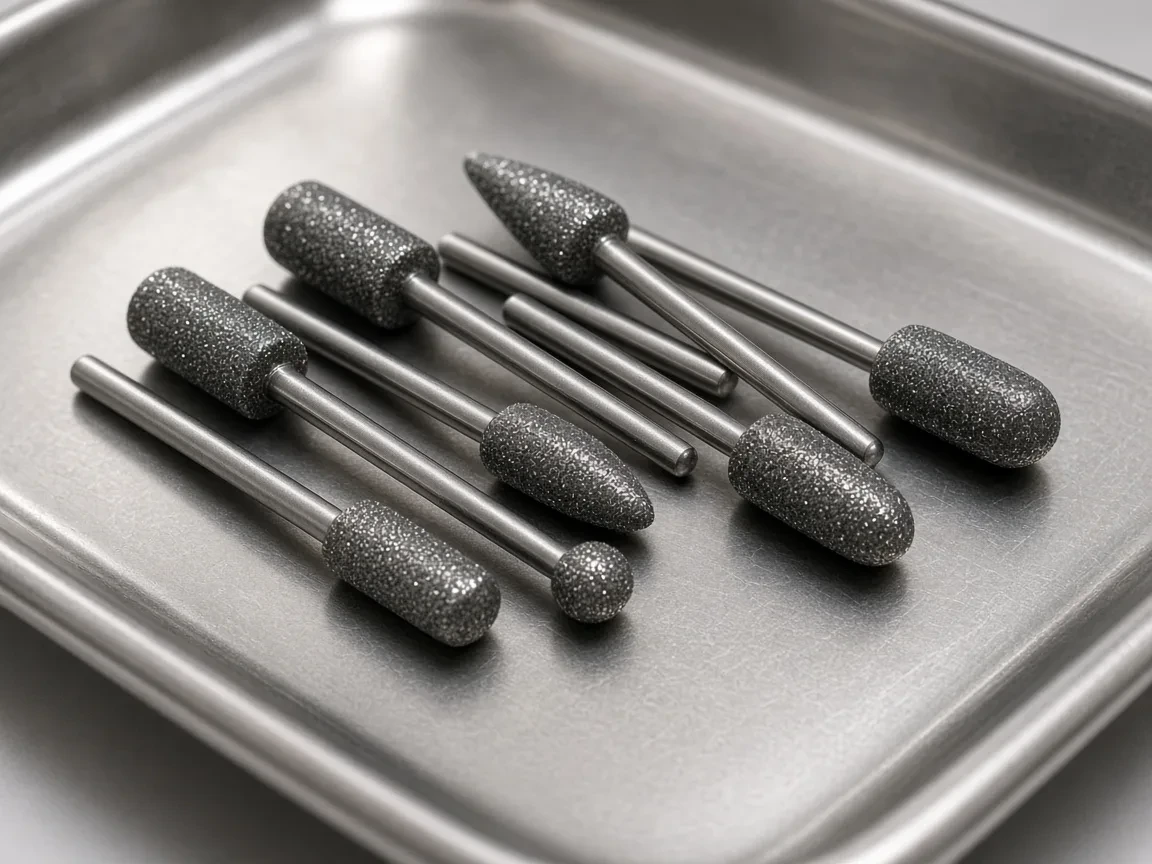
Dental Diamond Burs: How to Choose.
How to choose a diamond bur: grit color, friction-grip or latch, and how Alpen, Spring, and Two Striper differ.

Reviewed by Dr. Sean Myran, DMDDoctor of Dental Medicine, University of Pennsylvania
How we rank explains how these product lists are ordered.
A diamond bur abrades enamel, porcelain, and ceramic. It does not cut tooth the way a carbide blade does, and it is not sharpened when the grit goes bald. The bur guide is the choice between diamond and carbide, and the shank that fits the handpiece. This page is the diamond shapes already listed here: the grit color on the bur, and whether that bur is friction-grip, latch, or a lab shank.
How to choose a diamond bur
- Read the grit on that bur. On these listings, yellow is extra fine, red is fine, green is coarse, and black is super coarse. Coarse and super coarse reduce. Fine and extra fine finish. A black super-coarse bur is the wrong last bur on a margin.
- Match the shank. FG is the high-speed friction grip. RA is the latch, and the only latch row here is the Two Striper flame. HP is the straight slow-speed or lab shank. Diamond Point’s 2.35 mm figure is that HP shank, which the listing also writes as 3/32 inch.
- Single-use or multi-use. A pre-sterile pack is opened for that patient. A multi-use diamond is sterilized and thrown out when the crystals are smooth. Neither kind is sharpened.
- Head size is not shank size. Where a listing prints a millimeter head, that number is the cutting end. Do not treat it as the chuck diameter.
How the diamonds on this list differ
Treat the table as the grit and the shank each listing prints, not a score.
| Bur | Grit the listing prints | Shank | Size the listing prints | Watch for |
|---|---|---|---|---|
| Patterson Singles football | Extra fine, yellow | FG, single-use, 25/pkg | #3916VF, 1.6 mm by 3.5 mm | Synthetic grit. A finishing football, not a crown-prep bur |
| Spring flame | Extra fine, yellow | FG, 25/pkg | #863, 1.2 mm by 10 mm | The product copy says natural diamond, made in the USA |
| Alpen x1 | Super coarse, black | FG, gamma-sterilized, 25/pkg | #856L tapered round end, 1.8 mm by 9.0 mm | Reduction, not polish. Single-use |
| Alpen multi-use football | Fine, red | FG, 5/pkg | #379, 1.6 mm by 3.5 mm | Reusable. Retire it when the red grit is bald |
| Two Striper flame | Coarse, green | RA latch | #291.4, 1.2 mm by 4.0 mm | Latch, not a high-speed chuck. The listing’s endo row |
| Singles cylinder | Coarse, green | FG, single-use, 25/pkg | #1800.8C, 1.2 mm by 8 mm | A long coarse cylinder. Not the yellow football above |
| Meisinger HP | Medium | HP | #801-027-HP, 2.7 mm diameter printed | Slow-speed or lab. Not an FG operative bur |
| TDA cylinder | Medium | FG, 5/pkg | #879-018-M, 1.8 mm diameter | The cross-channel cooling line is the listing’s claim |
| Diamond Point | Coarse, and the copy also says fine | HP, 2.35 mm (3/32 inch) | #78/1090 | The name says uncoated. The copy says precision-plated. The shank is the clear spec |
| Diamon-All | Coarse, black, on the HP photo. Fine, medium, and coarse are named | HP | Head size not printed | A lab finisher for metal and porcelain, not an FG bur |
Single-use friction grip
Patterson’s yellow football, Spring’s yellow flame, Alpen’s black #856L, and the green Singles cylinder are the single-use FG rows. Yellow finishes. Green and black reduce. Alpen x1 is the one the listing says is gamma-sterilized, 1.8 mm by 9.0 mm, 25 per package. Spring’s flame is the long extra-fine shape, 1.2 mm by 10 mm, and the product copy says natural diamond made in the USA. Do not finish a margin with the black #856L because it was the bur already in the handpiece.
Multi-use friction grip
Alpen’s red football #379 is fine grit, 1.6 mm by 3.5 mm, five per package, and the listing calls it multi-use. TDA’s medium cylinder #879-018-M prints a 1.8 mm diameter and a cross-channel the listing says carries water. Sterilize them and replace them when the crystals are worn flat. A red fine football is not a substitute for the black super-coarse Alpen, and a medium cylinder is not a polishing point.
Latch and lab shanks
Two Striper’s green flame is RA, #291.4, 1.2 mm by 4.0 mm. It latches into a contra-angle. It will not run in the friction-grip high-speed that takes the FG rows. Meisinger’s medium diamond is HP, with 2.7 mm printed as the diameter of #801-027-HP, for composite, ceramic, and metal on a slow-speed or lab motor. Diamond Point is the other HP row: the copy states a 3/32 inch, 2.35 mm shank, and it uses both “uncoated” and “precision-plated,” so order from the shank and the grit on the box. Diamon-All is the HP lab instrument whose listing names fine, medium, and coarse, and whose photo is a coarse black tapered pencil. The listing says a nonmetallic binder and that each use exposes a new surface. That is the product claim. It is not an operative FG diamond.
Related guides
Diamond bur questions
Do you sharpen a diamond bur?
No. The crystals wear down. A multi-use diamond is replaced. A single-use diamond is discarded after the patient. Sharpening is a carbide-blade idea, and it does not apply here.
Which color is the finishing grit?
On this list, yellow is extra fine and red is fine. Green is coarse and black is super coarse. Finish with the finer color. Reduce with the coarser one. Confirm the band on the bur in your hand, because a shape name alone does not tell you the grit.
Related articles
Keep exploring related topics from Dental Country.
Dental Glass Ionomer Restoratives: How to Choose
How to choose a glass ionomer restorative: Fuji II LC, EQUIA Forte, packable Fuji IX, and Ketac Silver cermet.
Read article
Dental Orthodontic Elastomerics: How to Choose
How to choose orthodontic elastomerics: Patterson ligatures, chains, patient elastics, separators, and a color wheel.
Read article
Dental Rubber Dam Clamps: How to Choose
How to choose a rubber dam clamp: winged, wingless, Brinker, and serrated clamps from Hu-Friedy, Coltene, and Kulzer.
Read article
Dental Latex Dam Sheets: How to Choose
How to choose a latex dam sheet: gauge, size, and scent across Coltene Hygenic, Patterson Super Dam, Cranberry, and Medicom.
Read article