
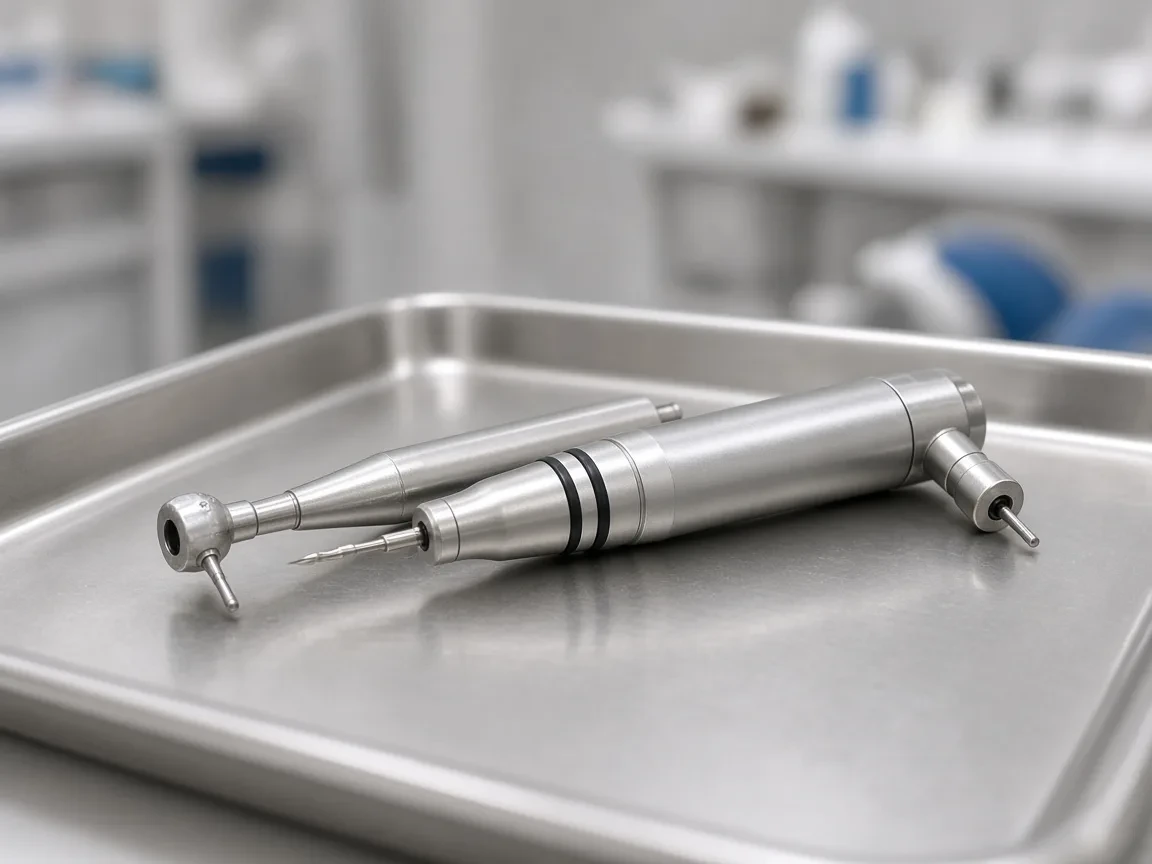
Dental Handpieces: How to Choose.
How to choose a dental handpiece: air versus electric, high-speed versus slow-speed, and how W&H, NSK, Morita, and Midwest differ.

Reviewed by Dr. Sean Myran, DMDDoctor of Dental Medicine, University of Pennsylvania
How we rank explains how these product lists are ordered.
A handpiece is the drill in the dentist’s hand. A high-speed is the turbine or the electric attachment used to cut tooth. A slow-speed is the contra-angle for finish, polish, and decay removal. A hygiene handpiece for a disposable prophy angle is a third tool. This page is the operative choice: air versus electric, and which coupling the delivery unit will accept. Burs are the carbide bur guide. The air that spins a turbine is the compressor.
How to choose a dental handpiece
- Air or electric. An air turbine is light and loud, and it needs clean, dry air. An electric motor holds torque when the bur is loaded, and it is heavier and quieter. Many offices keep air turbines for routine preps and add one electric motor for crowns and sectioning.
- High-speed and slow-speed are both required. A high-speed does not replace the contra-angle. Quote the slow-speed attachment with the high-speed, including the latch or friction-grip heads you actually use.
- The coupling is the purchase. The tubing on the delivery unit accepts a specific connection. A W&H handpiece, an NSK handpiece, a Morita handpiece, and a Midwest handpiece do not share one coupler. Name the coupler on the quote before you name the color of the hose.
- Fiber optics. If the delivery has a light, the handpiece has to pass that light. A non-optic handpiece on an optic hose is a dark prep.
- Hygiene is a different handpiece. A prophy handpiece such as a Nupro-style hygiene angle is not the operative turbine. Do not let it fill a “handpiece” line on a restorative quote.
How common handpiece lines differ
Treat the table as product differences, not a score. The coupler on your delivery unit decides which of these you can connect.
| Line | Known for | Best fit | Watch for |
|---|---|---|---|
| W&H Synea | Air turbines and electric attachments in one family | Offices that want air and electric from the same handpiece maker | The turbine and the electric motor use different connections. Quote both |
| NSK S-Max | Air turbines sold widely through U.S. dealers | Offices comparing an air high-speed against W&H or Midwest | Confirm the coupling matches the delivery hose, not just the brand the dealer stocks |
| Morita TwinPower | Air turbines with a different rotor layout from a standard single turbine | Offices that want an air high-speed and already use Morita equipment | It is still an air handpiece. It does not replace an electric motor |
| Midwest Stylus | Dentsply Sirona air handpieces on the coupler many U.S. units already have | Offices whose hoses are already Midwest | A Midwest hose does not accept a W&H or NSK turbine without the matching coupler |
W&H Synea
Synea is the W&H line that includes both an air turbine and an electric system. Offices look at it when they want one company for both. The turbine and the electric motor are still two purchases, and the electric side needs the motor, the hose, and the attachments. A Synea turbine on a Midwest hose is the mismatch to catch on the quote.
NSK
S-Max is the NSK air turbine dealers commonly put next to W&H and Midwest. Compare it on the coupling you have, on whether the optic version matches your hose, and on who rebuilds the turbine locally. An electric NSK motor is a separate line from the S-Max turbine. Do not assume the turbine quote includes it.
Morita TwinPower
TwinPower is Morita’s air high-speed. The rotor is the difference Morita sells against a conventional turbine. It still runs on compressed air, and it still needs the Morita coupling. Offices that already have Morita imaging or chairs sometimes stay here for one service relationship. The air requirement is the same as any other turbine: dry air from the compressor, or the bearings do not last.
Midwest Stylus
Stylus is the Dentsply Sirona Midwest air handpiece. It matters because a large number of U.S. delivery units were plumbed for a Midwest coupler. If that is the hose on the unit, a Stylus is the handpiece that connects without an adapter. Adapters exist and they are the part that fails first. If you are changing brands, change the coupler on purpose and put it on the quote.
Related guides
Handpiece questions
Can one electric motor replace every air turbine?
It can cover the high-speed and the slow-speed if you buy the attachments, and the office still needs a backup when that motor is out for repair. Most offices keep at least one air turbine for that reason.
Does a new handpiece fit the old delivery unit?
Only when the coupler matches. Look at the end of the hose before you look at the brochure. The delivery guide is the unit those hoses come from.
Related articles
Keep exploring related topics from Dental Country.
Dental Lasers: How to Choose
How to choose a dental laser by wavelength: diode, erbium, CO2, and Nd:YAG, and how Biolase, Fotona, Convergent, Ultradent, AMD, and Millennium differ.
Read article
Dental Loupe Headlamps: How to Choose
How to choose a loupe headlamp: a mount that fits the frame, a pack or a cordless light, and how Designs for Vision, Orascoptic, and Lumadent differ.
Read article
Dental Operating Microscopes: How to Choose
How to choose a dental operating microscope: the mount, the magnification steps, and how Zeiss, Global, and Zumax differ from loupes.
Read article
Dental Ultrasonic Scalers: How to Choose
How to choose an ultrasonic scaler: magnetostrictive versus piezo, and how Cavitron, Acteon, EMS, and NSK differ.
Read article