
Top 10 Rubber Dam Clamps for Root Canals.
Compare winged, wingless, Brinker, and serrated rubber dam clamps from Hu-Friedy, Coltene, and Kulzer for root-canal isolation.
How to Choose a Rubber Dam Clamp for Root Canals
A rubber dam clamp is the small piece of steel that makes isolation actually hold. It seats on the tooth, stretches the dam, retracts gingiva just enough to see the margin, and keeps irrigant, files, and debris out of the airway. For root canals, the clamp that “wins” is the one that stays put on that specific tooth without crushing tissue or launching off a broken-down crown.
Most clamp catalogs still use the Ivory numbering system. Winged clamps (plain numbers such as 2, 8A, 14A) let you carry the dam, clamp, and frame to the tooth in one motion, then slide the sheet off the wings. Wingless clamps (W2, W8A, W14A) go on first; you stretch the dam over them. Neither method is universally better — winged is faster for routine molars, wingless is easier when the tooth is short, rotated, or already has a temporary on it.
Buy for the teeth you actually isolate, not for a pretty complete set. A molar-heavy endo day needs flat-jawed lower clamps (7 / W7), sloped or serrated upper molar clamps (8A, 12A/13A, 14A), and at least one tiger or Brinker option for teeth that will not retain a smooth jaw. Premolar and anterior cases need smaller bicuspid clamps and a 9 / W9. Finish matters under a bright operatory light: matte or black coatings cut glare; gloss is easier to wipe and inspect for fatigue cracks.
Buying criteria that actually change the outcome
- Jaw shape vs tooth — flat jaws for intact molars, festooned or sloped jaws for partially erupted or conical teeth, serrated “tiger” jaws when enamel is gone and you are gripping restorative material or remaining root.
- Winged vs wingless — match the placement method your assistant already uses. Mixing both in one cassette is fine; mixing them mid-procedure is not.
- Tension and memory — a clamp should spring back after autoclave cycles. Soft, over-opened clamps leak. Overly stiff clamps bruise papilla and can crack weakened cusps.
- Finish and contrast — satin, matte, or black coatings help you see the rubber and the access outline; shiny steel is traditional and easier to spot cracks.
- Organization — color-coded Fiesta clamps and a peg organizer save more chair time than another “universal” molar clamp you cannot find in the cassette.
Clamp comparison
| Clamp / line | Maker | Placement | Finish | Best use | Watch-out |
|---|---|---|---|---|---|
| Dentech bicuspid clamps | Dentech | Typically winged | Polished stainless | Premolar isolation on a budget | Narrower catalog than Ivory or Hygenic |
| Ivory stainless clamps | Kulzer | Winged and wingless | Shiny or matte | Full-mouth everyday endo | Smooth jaws can slip on broken-down teeth |
| Hygenic gloss winged | Coltene | Winged (dam + clamp + frame together) | Gloss | Fast routine isolation | Glare under LED loupes |
| Black Line | Hu-Friedy | 48 USA-made styles | Satin Steel with dark coating | High-contrast molar and anterior endo | Coating can wear; inspect for steel shine-through |
| Ivory Tiger | Kulzer | Mostly winged (1T, 2T, 9T, 14T, 56T…) | Stainless, serrated jaws | Compromised or temporary-covered teeth | Serrations can nick soft tissue if overseated |
| Fiesta color-coded | Coltene | Winged or wingless | Matte, color ID | Busy multi-op trays | You are paying for organization, not a new jaw design |
| Brinker B1–B6 | Coltene | Wingless tissue retractors | Steel | Class V, subgingival margins, crown preps | Wrong size lacerates gingiva; not a first-line endo molar clamp |
| Fiesta 9-clamp set | Coltene | Winged or wingless 9-paks | Matte + organizer | New cassette / teaching clinic | Still need a tiger or Brinker for odd teeth |
| Brinker universal set | Coltene | B1–B6 together | Steel | Labs and restorative offices that retract often | Overkill if you only do molar RCT |
| Hygenic winged System-9 | Coltene | Winged 1, 2, 4, 7, 8A, 9, 12A, 13A, 14A | Gloss | Core endo/restorative clamp kit | No color coding; 12A/13A are left/right specific |
Latex rubber dam sheets · Latex-free dams · Dam frames
1. Rubber Dam Clamps, Bicuspid — Dentech Corp

Dentech’s bicuspid clamps are straightforward stainless-steel premolar clamps sold as individual sizes rather than a branded “system.” They exist to do one job: seat on an upper or lower premolar, hold the dam below the height of contour, and stay out of the way of a high-speed or an endo access.
Stainless construction is the entire story — corrosion-resistant, autoclavable, with enough spring to retain a 6" × 6" sheet on a typical bicuspid. There is no color code, no black coating, and no published hand-set tension ritual. That is not a defect if you already know which Ivory-style number you want and you are replacing lost clamps without rebuilding the whole cassette.
Who it is for: offices that isolate premolars often (restorative Class II, single-canal bicuspid RCT) and want spare steel without paying for Fiesta organization or Black Line contrast.
Tradeoff: the line is narrower than Ivory or Hygenic. If you need serrated jaws, offset molar pairs, or Brinker-style retraction, you will still buy those elsewhere. Inspect the bow for fatigue; inexpensive clamps are the ones most often over-opened on the forceps.
2. Ivory® Rubber Dam Clamps — Kulzer

Ivory is the numbering system everyone else still copies. Kulzer still makes the stainless Ivory line with factory hand-set tension — each clamp number is sprung for the tooth it is labeled for, not as a one-stiffness-fits-all stamping. Clamps are die-cut, heat-treated, and sold in shiny or matte finishes.
The catalog covers anteriors, premolars, and molars in winged and wingless versions, including the familiar 2 / 2A bicuspids, 7 / 8A molars, 9 anteriors, and 14A for large or partially erupted molars. If a new graduate says “hand me a W8A,” they are speaking Ivory even when the steel in the cassette is Coltene or Hu-Friedy.
Who it is for: general and endo practices that want one manufacturer’s full range and a finish choice. Matte is easier on the eyes under LED; shiny makes hairline cracks in the bow easier to see at sterilization.
Tradeoff: smooth jaws are excellent on intact enamel and honest crown margins. They are the wrong first pick on a crumbling temporary or a root-canal tooth that is only a ferrule and composite. That is what the Tiger line (below) is for. Ivory does not color-code sizes, so a mixed cassette still needs a good organizer.
3. Hygenic® Rubber Dam Clamps — Coltene

Coltene Hygenic (also sold under the HySolate label) winged clamps are built around a specific placement sequence: load the dam on the wings, carry clamp + sheet + frame to the tooth, seat the jaws, then stretch the dam off the wings. Coltene’s own catalog copy is explicit — winged projections exist so those steps can be combined.
The gloss-finish winged line is the un-coded workhorse: high-quality steel, easy to wipe, easy to inspect. Common numbers (2, 2A, 4, 7, 8A, 9, 12A, 13A, 14A) match what most US endo cassettes already contain. 12A and 13A are serrated, side-specific molar clamps for lower third molars and partially erupted teeth — they are not interchangeable left-to-right.
Who it is for: four-handed endo and restorative teams that already isolate with winged technique and want replacements that behave like the rest of the Hygenic dam, frame, and forceps system.
Tradeoff: gloss reflects operatory light. If you work under bright loupes or a microscope, matte Fiesta or Hu-Friedy Black Line will be less fatiguing. Winged clamps are also bulkier on a short clinical crown; switch to wingless rather than forcing the wings past a tight rubber.
4. Black Line Rubber Dam Clamps — Hu-Friedy

Hu-Friedy’s Black Line clamps are the same USA-made Satin Steel® family the company has long used for corrosion resistance, flexibility, and “memory,” with two visibility changes: a dark coating for intraoral contrast and a matte finish that cuts glare. Hu-Friedy publishes 48 styles for full-mouth coverage and heat-treats them for a secure fit.
That combination matters more in endo than in a five-minute sealant. A black bow against a green or blue dam makes the access outline and the clamp jaws easier to track, especially on upper second molars where the light is already bouncing off a mirror. Offset molar pairs (for example #30 / #31) exist for left/right upper molars — buy them as a pair, not as a single “universal.”
Who it is for: microscope-oriented endodontists and restorative dentists who already standardized on Hu-Friedy steel and want less eye fatigue, not a different jaw geometry.
Tradeoff: you pay a premium for coating and USA manufacturing. The coating can wear at contact points; once bright steel shows through, the contrast advantage is gone even if the spring is still fine. These are not tissue retractors — use Brinker clamps when the problem is gingiva, not glare.
5. Ivory® Tiger Rubber Dam Clamps — Kulzer

Tiger clamps are Ivory clamps with serrated jaws. Kulzer and its dealers describe them the same way: factory hand-set tension, plus teeth on the jaw to hold structurally compromised teeth. Published Tiger numbers include 1T (upper bicuspid), 2T and 2AT (lower / large-neck premolars), 9T (anterior labial), 14T (partially erupted molar), 14DT (distal-access molar), and 56T (large molars).
Use them when a smooth clamp walks off: a temporary crown, a cracked clinical crown, heavy composite, or a molar that is mostly orifice and remaining root. The serrations bite restorative material that polished steel cannot. They are still not a substitute for a well-fitted band or for building a pre-endo build-up when there is no ferrule left.
Who it is for: endo and restorative clinicians who already own smooth Ivory or Hygenic clamps and keep losing isolation on broken-down posterior teeth.
Tradeoff: serrations can indent gingiva and can scratch ceramic or gold if you park the clamp on a finished restoration you intend to keep. They also concentrate force — do not crank a Tiger onto a thin remaining cusp and then blame the clamp when the cusp shears.
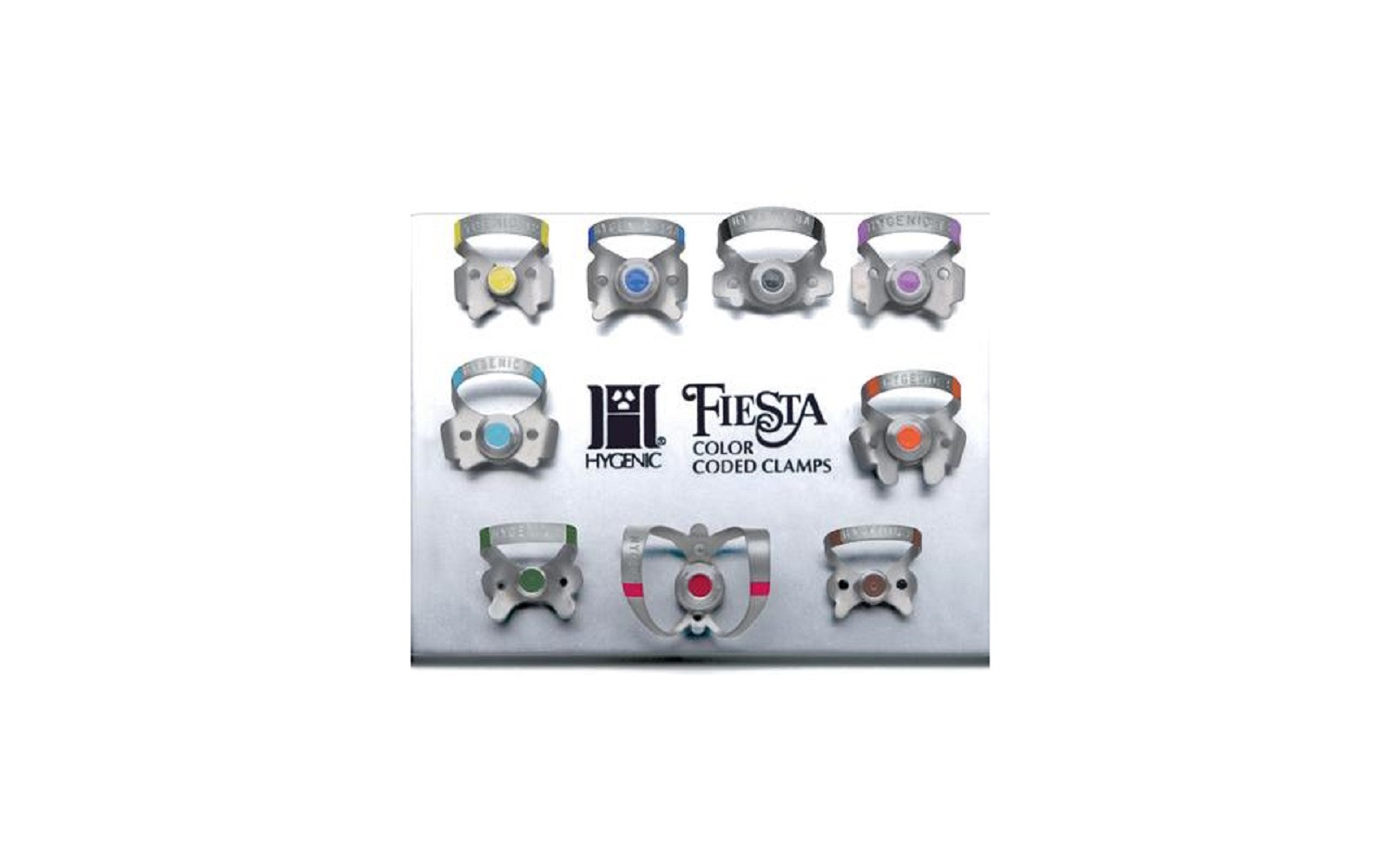
6. Hygenic® Fiesta® Color-Coded Clamps, Matte Finish — Coltene

Fiesta clamps are Hygenic clamps with two workflow features: individual color coding so size 2 does not look like size 8A in a wet cassette, and a matte finish that reduces reflection. Coltene sells the same jaw designs as the gloss line — winged and wingless — including W2 / W2A premolars, W7 / W8 molars, W9 anteriors, and W56 as a universal molar option.
The matte + color combination is aimed at identification speed, not at a new clinical indication. If your assistant can grab the correct clamp without flipping numbers, you save more time than you would from a slightly different bow. Colors also survive better than engraved numbers once the clamp is in the ultrasonic.
Who it is for: multi-operatory practices and teaching clinics where several people share a clamp drawer and mis-grabs are common.
Tradeoff: you are buying organization. The steel and jaw shapes are still Hygenic. If glare is your only complaint, Black Line may contrast better against the dam; if retention on a wrecked molar is the complaint, add a Tiger or 12A/13A instead of another color-coded W8.
7. Hygenic® Brinker Clamps, Tissue Retractors B1–B6 — Coltene

Brinker clamps are wingless tissue retractors, not general-purpose molar clamps. Coltene lists B1 for lower molars and pedo, B2 for upper left molars, B3 for upper right molars, B4 for bicuspids and anteriors, and B5 / B6 for all bicuspids and incisors. The jaws are meant to retract gingiva and expose a subgingival margin without cutting it.
That is a different problem than isolating a molar for RCT. Class V restorations, cervical abrasion, crown margins dropped below the gingiva, and some veneer or isolation-for-bonding cases are the usual reasons to reach for a Brinker. They can also help when a standard clamp hides the finish line you need to see.
Who it is for: restorative and prosthodontic operators who already own everyday winged/wingless clamps and still cannot see or keep dry a subgingival margin.
Tradeoff: using B2 on the wrong side, or a B1 on a thin fragile papilla, is how these clamps get a bad reputation. They are not a shortcut for a molar that simply needs an 8A or 14A. Seat slowly, floss the dam, and do not treat retraction as a substitute for a cord or a laser when the tissue is thick and inflamed.
8. Hygenic® Fiesta® Color-Coded Clamps, Sets — Coltene

The Fiesta set is the color-coded line sold as a kit: nine clamps plus a stainless organizer with matching color pegs. Coltene’s winged Fiesta 9-pak typically includes 2, 2A, 4, 7, 8A, 9, 12A, 13A, and 14A. The wingless 9W pak uses W2, W2A, W3, W7, W8, W8A, W9, W14A, and W56. That is a real everyday mix — premolars, a small molar, general-purpose upper and lower molars, an anterior, and at least one sloped or serrated molar option.
The organizer is the feature you notice at 7:30 a.m. Clamps dry in assigned slots, numbers are obvious from color, and the cassette is harder to put away incomplete. For a new associate operatory or a hygiene-to-restorative room that suddenly needs isolation, this is a faster start than buying ten loose numbers from three brands.
Who it is for: practices building or replacing a clamp cassette and willing to standardize on Coltene’s numbering and colors.
Tradeoff: a 9-pak is not a complete endo hospital. You will still want a Tiger for wrecked teeth and a Brinker set if you do subgingival restorative work. Decide winged vs wingless before you order; buying both “just in case” doubles the drawer without doubling skill.
9. Hygenic® Brinker Universal Clamp Set

The Brinker universal set is one of each B1–B6, sold together (Coltene catalog H01054) and also available as singles. It is the retraction kit for an office that sees mixed restorative work — lower molars, both upper molar sides, and a few anterior/bicuspid retractors — without guessing which single Brinker to stock.
Because Brinkers are side- and site-specific, a complete set prevents the common failure mode of stretching a B5 to do a B2’s job. Keep them in a separate pouch from everyday winged clamps so nobody grabs a tissue retractor when they meant to grab a W8A.
Who it is for: crown-and-bridge and restorative-heavy offices, and endo practices that also restore deep cervical lesions or finish margins after isolation.
Tradeoff: if 90% of your rubber dam use is molar RCT on intact crowns, this set will sit unused. Buy the winged System-9 first. Brinkers also require a lighter touch than a retentive molar clamp; train the team that these jaws retract tissue, they do not “lock” a tooth the way a 14A does.
10. Hygenic® Rubber Dam Clamps System — Winged

Coltene’s gloss System-9 winged pak (H02701) is the un-coded sibling of the Fiesta 9-pak: one each of 1, 2, 4, 7, 8A, 9, 12A, 13A, and 14A. That mix covers anteriors, premolars, general-purpose lower molars, sloped small molars, and both serrated lower third-molar clamps plus a large/partially erupted molar clamp.
This is the kit to buy when the technique is already winged and you do not want to pay for color. It pairs cleanly with Hygenic latex or non-latex sheets and a plastic or metal frame. 12A and 13A in the box are the reminder that “molar clamp” is not one instrument — left and right serrated lowers are different pieces of steel.
Who it is for: a new endo cassette, a satellite office, or a GP who isolates for posterior composites and occasional RCT and wants one closed set instead of a junk drawer of mixed brands.
Tradeoff: no matte coating, no colors, no Brinkers, no Tigers. Add those only after you know which teeth in your schedule keep leaking. Replacing a sprung 8A is cheaper than replacing a whole pak — buy the set for coverage, then buy singles as they fatigue.
Frequently Asked Questions
Winged or wingless clamps for root canals?
Use winged clamps if you place the dam, clamp, and frame together and then slide the sheet off the wings. Use wingless clamps when the tooth is short, the rubber is heavy, or you want the clamp seated and stable before stretching the dam. Many endo cassettes carry both; the mistake is switching methods mid-tooth.
What clamp number do I need for a molar root canal?
There is no single molar clamp. A 7 or W7 is a common flat-jawed lower molar; 8 / W8 or 8A / W8A covers many uppers; 14A / W14A is the usual pick for large or partly erupted molars; 12A and 13A are serrated, side-specific lowers. Fit the jaws to the tooth’s height of contour, not to a ranking list.
When should I use a Brinker clamp instead of a regular dam clamp?
Brinker B1–B6 clamps are tissue retractors for subgingival margins — Class V restorations, cervical finish lines, some crown preps. They are a poor first choice for routine molar RCT isolation. If the tooth will not retain a standard clamp, consider a tiger/serrated jaw or a pre-endo build-up before you reach for a Brinker.
Do black or matte clamps work better than shiny stainless?
They do not hold the dam better. Hu-Friedy Black Line and Coltene Fiesta matte finishes reduce glare and, in Black Line’s case, add dark contrast against the dam. Choose them for visibility. Choose serrated jaws or a different clamp number if the problem is retention.
Read next
Stay on the isolation kit, not marketing roundups:
Related articles
Keep exploring related topics from Dental Country.
Top 10 Flowable Dental Composites
Flowable composite buying guide: SDR flow+ 4 mm bases versus Giomer, heavy-flow, and shade-matched liners.
Read article
Top 5 Acrylic Resin Brands for Denture Repair
Denture acrylics by job: Lucitone 199 heat-cure bases, Rebase II chairside relines, and self-cure repair resins.
Read article
Top 10 Bottle Cleaners for Dentists
Compare the best Bottle Cleaners for Dentists — our researched Top 10 ranking of the leading brands and options to help you choose the right fit for your practice.
Read article
7 Dental Websites to be Inspired by
Compare the best 7 Dental Websites to be Inspired by, ranked on performance, features, and value to help you choose the right fit for your practice.
Read article