
Impression Materials: How to Choose.
How to choose among alginate, VPS (PVS), and polyether: moisture, pour time, tear, and which ADA specification applies.

Reviewed by Dr. Sean Myran, DMDDoctor of Dental Medicine, University of Pennsylvania
How we rank explains how these product lists are ordered.
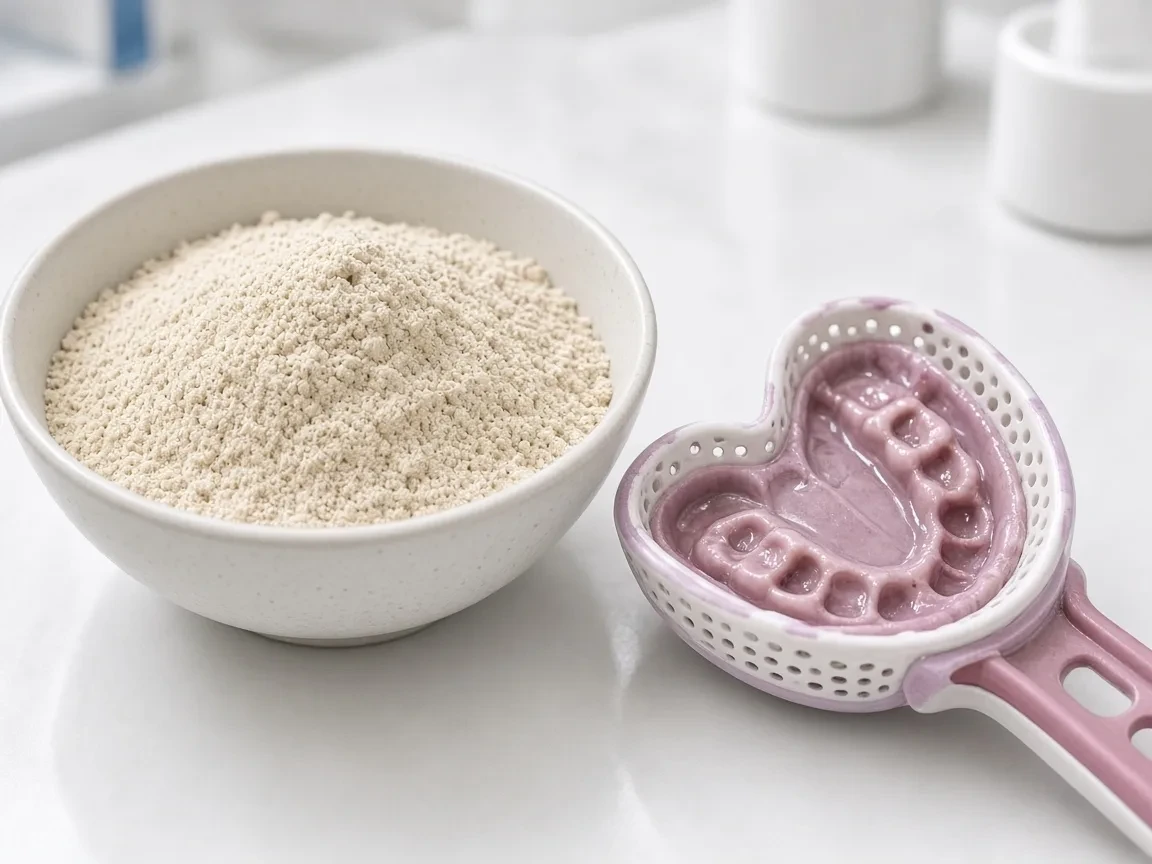
An impression material records the size of oral tissues and how those tissues sit relative to each other. The material is placed while it is plastic, it sets, and the removed impression is a negative of the tissues. Stone or another cast material poured into that negative becomes the positive. Craig’s Restorative Dental Materials calls the positive a model or cast when it covers a large area, and a die when it records a prepared tooth. The same chapter lists what an ideal impression material would do: reasonable handling and cost, adequate flow and wetting, a workable set, enough elastic recovery and tear resistance to come out of the mouth, dimensional accuracy that holds, a taste and odor a patient can accept, safety, no important loss of properties after disinfection, compatibility with the cast material, and a useful shelf life. No current material does all of that.
A material that is rigid when set is limited to areas without undercuts. On a tooth with a bulge, a rigid set locks in place and can fracture on the way out. Flexible materials are the ones used for dentate arches. The three flexible materials this guide compares are alginate, addition silicone, and polyether. Addition silicone is also called polyvinyl siloxane, VPS, or PVS. Craig’s chapter estimates use in restorative procedures at about 51% addition silicone, 32% polyether, 9% polysulfide, 6% hydrocolloid, and 2% condensation silicone. That is the textbook’s estimate, not a current sales census.
How to choose an impression material
- What you are recording. Alginate is used for study models of a full arch or a segment, and for models used to make athletic mouthguards. Craig’s chapter does not recommend it for impressions of cavity preparations. The reasons given there are low tear strength and less surface detail transferred to a gypsum die than an elastomeric impression transfers.
- Moisture. Conventional vinyl polysiloxane is hydrophobic. A 2018 review in Dentistry and Medical Research explains that with the chemistry: hydrophobic aliphatic hydrocarbon groups surround the siloxane bond, and a wet surface can leave voids. The review says to control moisture before a VPS impression if you want the surface detail. Some VPS products add surfactants so fewer voids show up in the stone. Those surfactants act on the liquid they touch. They do not turn the siloxane itself into a polyether. Polyether carries carbonyl and ether groups. The same review calls polyether the most hydrophilic elastomer, followed by polysulfide, then silicones, and says polyether is more likely to record detail when moisture is present. It also says the best polyether result is still a dry field.
- When the cast will be poured. Set alginate holds a lot of water. Stored in air, it shrinks as water leaves. Stored in water, it swells. Craig’s chapter names the slow shrinkage that continues even in humid air: syneresis, water forming on the surface of the gel. Pour as soon as you can. If you cannot, the chapter’s next-best storage is about 100% relative humidity for as short a time as possible. ANSI/ADA Specification No. 18 (ISO 1563) is the alginate specification summarized in that chapter. It requires at least 95% elastic recovery (no more than 5% permanent deformation) when the set material is compressed 20% for 5 seconds, a compressive strength of at least 0.37 MPa at removal, and enough detail to transfer a line 0.075 mm wide to gypsum.
- How you remove an alginate impression. Tear strength in the Craig chapter ranges from about 3.7 to 6.9 N/cm. Thin sections tear under a small force. Tear strength is higher when the impression is removed quickly, and it is also higher if removal is delayed. The delay has a practical limit: the patient is still sitting there.
- Repours. The 2018 review says detail can still be reproduced from a polyether impression poured more than once over 1 to 2 weeks, and that polyether becomes more rigid over that time, which can distort the cast when the cast is separated from the impression. One in vitro comparison of Aquasil (a VPS) and Impregum (a polyether), run to ADA methods, found no significant difference in surface detail when both were dry. Under moisture, that study found the VPS ahead, which the reviewers connect to hydrophilized addition silicone, and they report the polyether’s dimensional stability was better than that VPS. That is one comparison of two products, not a ranking of every cartridge on the market.
How the three classes differ
| Class | What it is for | Moisture | After the impression |
|---|---|---|---|
| Alginate | Study models and mouthguard models. Not Craig’s recommendation for cavity preparations. | A water-based gel. It records in a wet mouth and then moves if you store it wrong. | Pour promptly. Air shrinks it, water swells it, syneresis shrinks it even in humidity. |
| Addition silicone (VPS/PVS) | The elastomer Craig’s usage estimate places first for restorative impressions. | Hydrophobic unless the formula adds surfactants. Control moisture before you seat it. | Elastomeric standard is ANSI/ADA Specification No. 19. This page does not assign a pour window to every brand. |
| Polyether | The other high-use elastomer in that estimate. | More hydrophilic than silicone. Still better when the field is dry. | The 2018 review describes repours over 1 to 2 weeks and increasing rigidity that can distort a cast on separation. |
Alginate
Alginate is an irreversible hydrocolloid. The powder contains a soluble alginate salt and calcium sulfate. Sodium phosphate reacts with calcium first, which is why it is called a retarder. When the phosphate is used up, calcium alginate precipitates as a gel. The gel does not return to a paste. Warmer mixing water shortens working time and setting time. Under Specification No. 18, as Craig’s chapter states it, a normal-set alginate should set no sooner than 2 minutes and no later than 4½ minutes after mixing starts, and it should stay workable for up to 2 minutes. A fast set falls between 1 and 2 minutes. Thicker mixes are less flexible and stronger. Thinner mixes take longer to set and deform more. Product names in the chapter’s table include Jeltrate Plus and Hydrogum 5. Those are examples of alginate, not a score. Product-level differences, including any storage time a manufacturer prints for one powder, are on the alginate buying guide.
Addition silicone (VPS or PVS)
Addition silicone is the restorative elastomer in the largest share of Craig’s usage estimate. Unmodified VPS wets poorly because of those hydrocarbon groups around the siloxane bond. Hydrophilized VPS is a different purchase: the 2018 review describes an intrinsic surfactant that leaves the surface when the material touches moisture, and extrinsic surfactants that lower the surface tension of the moisture without changing the VPS surface itself. Examples named in Craig’s table include Aquasil Ultra and Imprint 3. Specification No. 19 is the elastomeric impression-material standard this class falls under. Read the cartridge you are ordering for body (light, medium, heavy, putty) and for whether a surfactant is in that formula. This page does not rank them.
Polyether
Polyether is the second material in that same usage estimate. Hydrophilic groups are why the 2018 review expects better detail in moisture than from a conventional silicone, with the repeated limit that a dry field is still the better condition. Impregum is the polyether named in Craig’s product table. If the cast will be poured later, or poured again, use the review’s warning about rigidity: a polyether that has stiffened can distort the cast as the cast comes off. Specification No. 19 covers polyether as an elastomer. It is not Specification No. 18, and the alginate numbers above do not transfer to it.
Related guides
Impression questions
Can alginate record a crown preparation?
Craig’s chapter does not recommend alginate for impressions of cavity preparations. It is the material for study models and records such as mouthguard models. A preparation is an elastomeric impression.
Why does a VPS impression void when the tooth is wet?
Conventional VPS is hydrophobic. The 2018 review ties that to hydrocarbon groups around the siloxane bond and says to control moisture before the impression. A hydrophilized VPS adds surfactant to cut voids in the stone. That is not the same chemistry as polyether.
How soon should an alginate impression be poured?
Pour it as soon as you can. Air shrinks it, water swells it, and syneresis shrinks it even in humid air. If you must wait, Craig’s chapter says about 100% relative humidity for the shortest time is the least dimensional change.
Sources
Powers JM, Sakaguchi RL, editors
Craig’s Restorative Dental Materials. 13th ed. St Louis: Mosby; 2012. Chapter 8, Impression Materials. Alginate handling, Specification No. 18 limits cited above, tear and elastic-recovery figures, syneresis, and the restorative-use estimate are from this chapter.
Rameez M, Razi S, Farhan F, Kumar B, Rashid H
Clinical implications of elastomeric impression materials. Dentistry and Medical Research. 2018;6(1):19-23. doi:10.4103/dmr.dmr_10_17. VPS hydrophobicity, surfactants, polyether hydrophilicity, and the Aquasil/Impregum comparison summary are from this review.
ANSI/ADA Specification No. 18 for dental alginate impression materials (ISO 1563), as summarized in Craig’s chapter 8. Numeric alginate limits in this guide are those summaries, not a reprint of the standard.
ANSI/ADA Specification No. 19 for elastomeric impression materials
Cited here for scope: it is the elastomeric standard. This guide does not copy its test limits.
Related articles
Keep exploring related topics from Dental Country.
Dental Flowable Composites: How to Choose
How to choose a flowable composite: SDR flow+ 4 mm bases versus Giomer, heavy-flow, and shade-matched liners.
Read article
Dental Fluoride Varnishes: How to Choose
How to choose a fluoride varnish: 5% sodium fluoride unit doses and a 10 ml tube, plus TCP, CPP-ACP, and CXP rows.
Read article
Dental Glass Ionomer Restoratives: How to Choose
How to choose a glass ionomer restorative: Fuji II LC, EQUIA Forte, packable Fuji IX, and Ketac Silver cermet.
Read article
Dental Orthodontic Elastomerics: How to Choose
How to choose orthodontic elastomerics: Patterson ligatures, chains, patient elastics, separators, and a color wheel.
Read article