
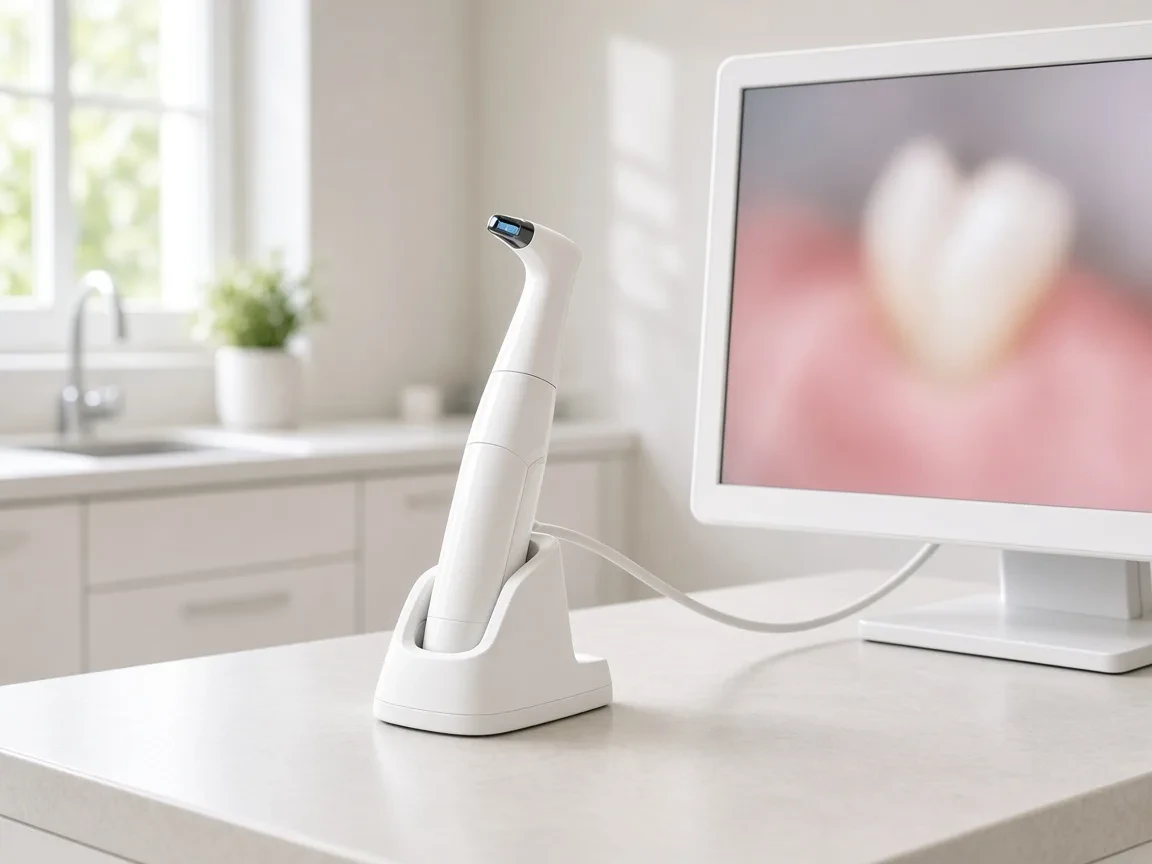
Intraoral Scanners: How to Choose.
How to choose an intraoral scanner for digital impressions: open STL files, Invisalign workflows, carts, and how TRIOS, iTero, Primescan, Medit, and Planmeca…

Reviewed by Dr. Sean Myran, DMDDoctor of Dental Medicine, University of Pennsylvania
How we rank explains how these product lists are ordered.
An intraoral scanner records a 3D surface of the teeth for crowns, bridges, aligners, dentures, and implant planning. It is not an intraoral camera, and it is not the phosphor-plate reader some older pages call a scanner. Those plate readers digitize a radiograph. This guide is about optical impressions.
How to choose an intraoral scanner
- Where the file has to go. An open scanner exports STL or PLY to the lab you already use. iTero is built around Align and Invisalign. Primescan is built around CEREC and a Sirona mill. Buy the path your cases actually travel.
- Cart, laptop, or wireless wand. A cart is stable and takes floor space. A laptop pod moves between rooms. A wireless wand removes the cable and adds a battery. Try a full-arch scan in the smallest operatory you have.
- Subscription. Some brands charge yearly software, cloud storage, or caries-detection features. Ask for the five-year cost, not the wand price on the proposal’s first page.
- What you scan. Full arches, edentulous ridges, implant scan bodies, and deep preps are different tests. A scanner that flies through a single crown prep can still struggle on a full denture impression.
- Who scans. If assistants scan, the wand weight, the heater, and the on-screen guidance matter more than a spec-sheet accuracy number you cannot verify in the office.
How the major scanners differ
| Brand | Known for | Best fit | Watch for |
|---|---|---|---|
| 3Shape TRIOS | Open export and a broad lab network | Offices that send STL files to more than one lab | Software tiers and apps are part of the ongoing cost |
| Align iTero | Invisalign and the Align workflow | Practices that submit a lot of Invisalign | Weaker reason to buy if you rarely do Align cases |
| Dentsply Sirona Primescan | CEREC chairside and Connect lab cases | Offices milling same-day restorations on a Sirona mill | You are buying a workflow, not only a wand |
| Medit | Open files at a lower acquisition cost | Offices that want STL output without a premium cart | Confirm the lab will accept the export without a conversion step |
| Planmeca Emerald | Scanning inside a Planmeca CAD/CAM and imaging setup | Offices already on Planmeca mills or Romexis | Less reason to choose it as a standalone wand |
3Shape TRIOS
TRIOS is the scanner offices pick when the lab relationship is “send a file,” not “stay inside one manufacturer.” Models differ by wired versus wireless and by which software apps are included. Caries-detection tools on later TRIOS wands are an add-on decision, not the reason to buy the scanner.
Align iTero
iTero is the practical choice when a large share of scans are Invisalign submissions. The wand, the Invisalign case pipeline, and Align’s ecosystem are the product. If those cases are rare in your office, you are paying for a path you will not walk, and an open scanner is the cleaner buy.
Dentsply Sirona Primescan
Primescan replaced Omnicam as Sirona’s chairside scanner. It makes the most sense next to a CEREC mill, where the same visit can go from scan to design to mill. If a lab makes your crowns, compare Primescan’s lab-connect fee with simply emailing an STL from TRIOS or Medit.
Medit
Medit scanners are the open, lower-cost wands that pushed premium brands to justify their subscriptions. The buying test is mundane: scan a deep margin, export the file, and have your lab open it. If that works, the rest is wand feel and the software renewal.
Planmeca Emerald
Emerald fits when the office already uses Planmeca for imaging or milling and wants the scan in that same environment. As a lone scanner in a practice that uses someone else’s mill and someone else’s lab portal, it has fewer advantages.
Related guides
Scanner questions
Do I need a scanner if my lab still pours models?
Only if you want to stop taking physical impressions. The lab can still print a model from an open scan. If every case is a triple tray and you like it that way, a scanner will sit.
What accuracy number should I trust?
None that you did not produce. Published trueness figures come from the manufacturer’s protocol. Scan a prep with a deep margin in your light, with your assistant, and send it to your lab. That is the accuracy you will live with.
Related articles
Keep exploring related topics from Dental Country.

Top 10 Dental Latex Rubber Dam Sheets
Compare latex dental dam sheets by gauge, size, and scent — Coltene Hygenic, Patterson Super Dam, Cranberry, and Medicom.
Read article
Top 10 Hand Waxing Instruments in Dentistry
Compare PK Thomas, LeCron, Roach, Akers, and TiN wax carvers for crown, partial, and denture wax-ups.
Read article
Dental Amalgam Separators: How to Choose
How to choose an amalgam separator: central or chairside, canister recycling, and how Solmetex, Rebec, Dürr, and Metasys differ.
Read article
Dental Instrument Washers: How to Choose
How to choose a dental instrument washer: cassette capacity, drying, and how SciCan HYDRIM, Melag, and Miele differ.
Read article