
Top 5 Core Buildup Materials in Dentistry.
Core buildups compared honestly: dual-cure LuxaCore and Clearfil versus cermet and light-cure composites.
How to Choose a Core Buildup Material
Only two products on this list are dual-cure core composites: LuxaCore Automix Dual and Clearfil DC Core Plus. Ketac Silver is a self-cure silver-cermet glass ionomer. Beautifil Flow Plus and Denfil are light-cure restorative composites that offices sometimes stack into a buildup. A ranking that calls all five “core composites” will get a post space filled with a material that never cures at the bottom.
The decision is depth and light. A core that starts in a post channel, or under a crown prep you cannot shine through, needs a dual-cure made for that job. A small, well-isolated blockout above the gingiva can be a light-cure restorative if you respect depth of cure. A wet, non-esthetic buildup that will disappear under a crown can be Ketac Silver — gray, radiopaque, and chemically setting — with the understanding that it does not bond or cut like a resin core.
Buying criteria that actually change the outcome
- Dual-cure vs light-cure — LuxaCore and Clearfil DC Core Plus set where the light does not reach. Beautifil Flow Plus and Denfil do not. Depth of cure is the whole argument.
- How it cuts — DMG’s claim for LuxaCore is that the cured core cuts similarly to dentin, so the bur does not ditch the tooth at the interface. Ketac Silver cuts harder than dentin. A light-cure universal composite cuts like whatever composite it is, which may be softer or stickier than dentin.
- Color at the margin — Ketac Silver is gray. If the crown margin does not cover it, the patient will see metal-colored glass ionomer. The dual-cure composites are tooth-colored.
- Adhesive system — a core composite is only as good as the bond and the post cement you pair with it. Clearfil DC Core Plus belongs with a Clearfil bonding protocol. Do not invent a bond the cartridge does not include.
- Fluoride vs retention — Giomer fluoride (Beautifil) and cermet fluoride (Ketac Silver) are real material stories. They do not replace mechanical retention and a ferrule.
| Material | Maker | What it actually is | Cure | Best use | Watch-out |
|---|---|---|---|---|---|
| Ketac Silver Aplicap | 3M | Silver cermet glass ionomer | Self-cure capsule | Cores and posterior fills that will be covered | Gray, and it cuts harder than dentin |
| Beautifil Flow Plus | Shofu | Giomer flowable restorative | Light-cure only | Small, shallow, well-isolated additions | Will not cure at the bottom of a post space |
| Denfil | Vericom | Light-cure universal composite | Light-cure only | Shallow buildups when you already stock the composite | Not a dual-cure core system |
| LuxaCore Automix Dual | DMG | Dual-cure core composite | Dual-cure automix | Cores and post cementation in the LuxaCore system | Needs the DMG bonding steps, not a random adhesive |
| Clearfil DC Core Plus | Kuraray | Dual-cure core composite | Dual-cure automix | Cores where light will not reach the base | Use the Clearfil bond protocol that matches this generation |
The filling you are building toward: core build-up materials · resin cements
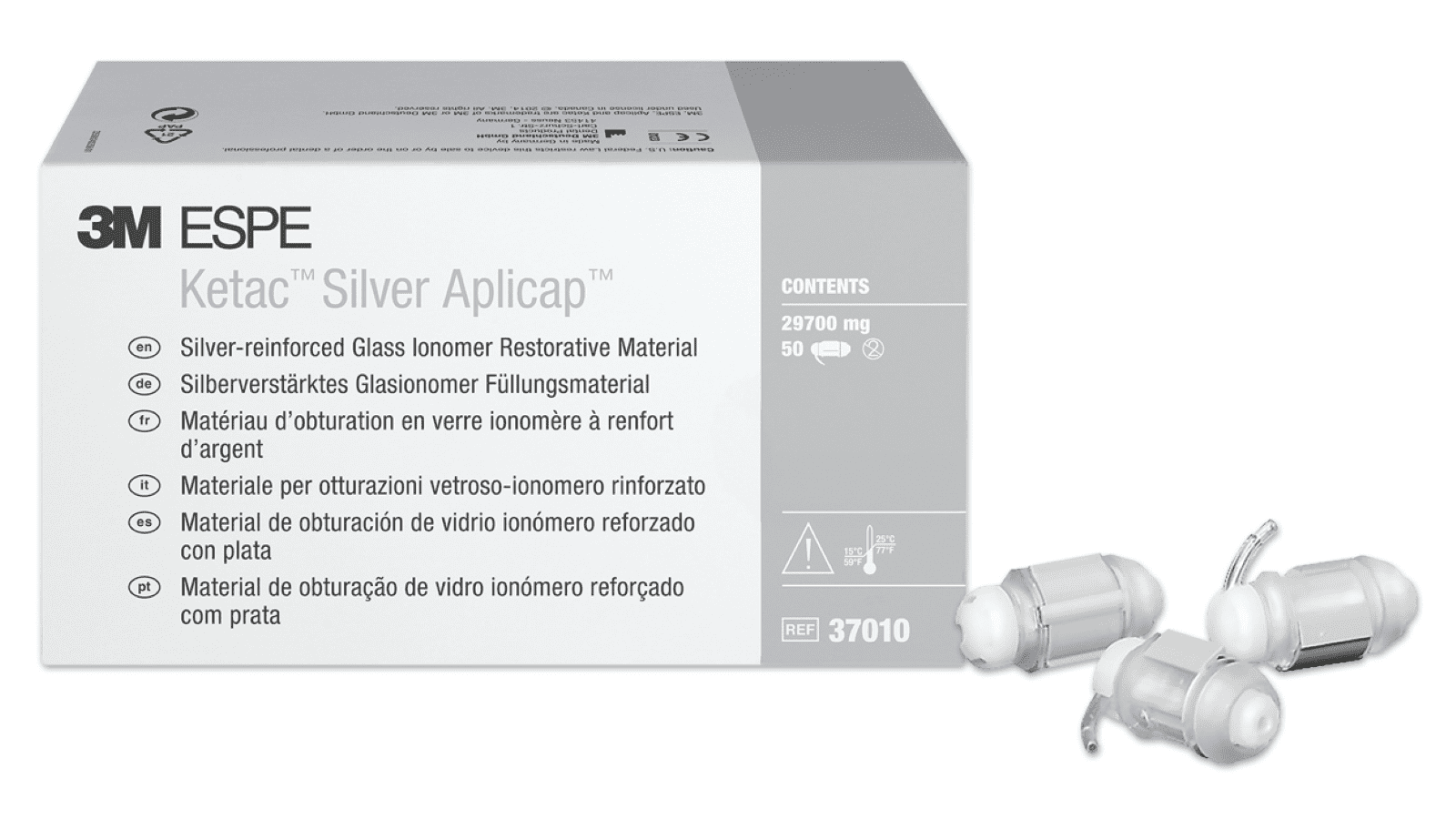
1. Ketac™ Silver Aplicap™ — 3M

3M Ketac Silver Aplicap is a silver-reinforced glass ionomer, a cermet, in a self-cure capsule. It is on core lists because it can bulk-fill a non-esthetic buildup, it is radiopaque, it releases fluoride, and it does not need a curing light. It is not a composite. The color is gray. Under a full-coverage crown that hides the margin, that can be acceptable. At a visible supragingival margin, it is not.
Self-cure means you wait for the chemical set before you prep. The silver phase cuts differently from dentin; burs tend to ditch the tooth rather than the core if you are not watching the interface. That is the opposite handling claim from LuxaCore. Adhesion is glass-ionomer adhesion, not a resin hybrid layer. A short clinical crown that needs the core itself to retain the crown is a weak place to rely on a cermet alone.
Who it is for: Buildups that will be fully covered, where isolation is imperfect and a tooth-colored dual-cure is more procedure than the tooth can support.
Tradeoff: Patients see gray if you leave it at the margin. It is a poor choice when you need to lute a post with the same material and then cut a dentin-like prep. Aplicap capsules need the 3M activator and applier. Do not treat a five-star reseller table as evidence; this is a cermet with a specific job.
2. Beautifil Flow Plus — Shofu

Shofu Beautifil Flow Plus is a light-cured Giomer restorative — S-PRG filler, with fluoride release and recharge in Shofu’s description — sold as a sculptable F00 and a more flowable F03. It is a legitimate small restorative and a legitimate small addition on top of a core. It is not a dual-cure core composite. Light has to reach the bottom of whatever you just injected.
Offices put it on core lists because the syringe is already open for Class V and blockout, and a shallow, isolated buildup can be layered and cured. That is a technique, not a product indication you can stretch into a post channel. The viscosity in the syringe matters: F00 stacks, F03 runs. Neither one self-cures in the dark.
Who it is for: Shallow, visible, well-isolated core additions in offices that already use Beautifil Flow Plus as a restorative and will cure every increment.
Tradeoff: Deep buildups and post spaces will have uncured Giomer at the base. Fluoride does not fix that. If the core is the foundation of a crown on a badly broken tooth, switch to LuxaCore or Clearfil DC Core Plus. Confirm F00 versus F03 on the label before you try to stack it.
3. Denfil — Vericom

Denfil is a light-cured restorative composite from Vericom, sold widely as an anterior and posterior filling material. It is not a dual-cure core system, it does not come with a post-cementation protocol, and it should not be described as one. Like any universal composite, it can build a shallow, accessible core if you place and cure increments the IFU allows.
The reason it appears on an older “core materials” ranking is catalog grouping, not a unique core feature. You get a tooth-colored light-cure resin with whatever strength and shade Vericom prints for Denfil as a restorative. You do not get DMG’s dentin-like cutting claim or Kuraray’s dual-cure chemistry. If Denfil is already the office composite, using it for a small buildup avoids a second shade. If the prep is deep, that convenience is the problem.
Who it is for: Practices that already restore with Denfil and only need a light-cured buildup in a shallow, isolated prep.
Tradeoff: No chemical cure. A post space filled with Denfil and given a casual occlusal cure is an uncured core. Do not invent bond-strength numbers or awards for it. Match the adhesive to a light-cure composite, and move deep cores to a material made for them.
4. LuxaCore Automix Dual — DMG

DMG LuxaCore Automix Dual is a dual-cure core buildup composite in an automix syringe. DMG also indicates the LuxaCore family for post cementation, so one material can lute the post and build the core when you follow that system. The handling claim to remember is cutting: DMG says the cured material cuts similarly to dentin, which is what keeps a bur from ditching the root face while you prep the crown.
Dual cure is why it is on this list next to two light-only composites and a cermet. The self-cure covers the part of the buildup the light never reaches. The light cure lets you stabilize the occlusal portion and move on. Automix ratio is only right if the tip is seated and the first squeeze is discarded the way DMG describes. A core that is mostly post cement still needs the adhesive steps in the IFU, not whatever bottle was already on the bracket table.
Who it is for: Crown-and-bridge practices that want a dual-cure automix core, dentin-like prep feel, and a material that can also cement the post in the same system.
Tradeoff: It is only dual-cure if both pastes are mixing. A clogged or short-changed tip is a light-cure-only accident inside a dual-cure syringe. Shade should disappear under the crown, not conflict with a ceramic margin you left on core material. Bond and fiber-post instructions are part of the product; the cartridge alone is not the system.
5. Clearfil DC Core Plus — Kuraray

Kuraray Clearfil DC Core Plus is a dual-cure, two-paste core composite in an automix syringe. Kuraray designed it for core buildup, including the deep part of a preparation where a light-cure restorative will not polymerize. Tooth-colored shades keep a supragingival island of core from looking like Ketac Silver. The bond is a Clearfil protocol — the generation of Universal Bond or DC Core Plus bond and activator that the current IFU names — not a generic “any adhesive.”
Use it when the core is a true foundation: endodontically treated teeth, post spaces, and buildups you will prep before a chemical-only set would be convenient. It is a different tool from Beautifil Flow Plus, even if both can sit on dentin in the same office. Flow Plus is a Giomer restorative. DC Core Plus is the dual-cure core.
Who it is for: Kuraray offices that want a dual-cure automix core and will use the matching Clearfil bonding steps.
Tradeoff: Dual cure does not excuse a contaminated canal or a skipped bond. Working time is finite once the pastes meet; stage the post and the matrix before you mix. Do not pair it with a self-adhesive cement habit from a different brand unless that combination is written down. Tooth-colored core at the margin can still shadow a translucent crown if the shade is too opaque — pick the shade the way you would a cement.
Frequently Asked Questions
Which materials on this list cure without light?
LuxaCore Automix Dual and Clearfil DC Core Plus are dual-cure, so they set chemically where light is blocked and can also be light-cured. Ketac Silver is a self-cure cermet with no light cure. Beautifil Flow Plus and Denfil are light-cure only.
Can I use Beautifil Flow Plus as a core?
Only as a shallow, incremental, light-cured addition you can fully cure. It is a Giomer restorative, not a dual-cure core. It should not be the material you inject to the end of a post space.
Why does LuxaCore’s cutting claim matter?
DMG describes the set material as cutting similarly to dentin, so the bur stays even across the junction while you prep. Ketac Silver is harder than dentin and tends to ditch the tooth. A soft or sticky universal composite ditches the other way. The prep tells you which core you used.
Is Ketac Silver a composite core?
No. It is a silver-reinforced glass ionomer. It is radiopaque, gray, fluoride-releasing, and self-cure. Use it when the crown will cover the color and a resin bond is not the plan. Use a dual-cure composite when the core has to retain and the margin might show.
Read next
Stay on buildups and the crowns they support:
Related articles
Keep exploring related topics from Dental Country.
The Top 15 Dental Chairs in the World
Compare 15 dental chair brands for 2026 — A-dec, Planmeca, Midmark, and more — by ergonomics, service, and cost.
Read article
Top 10 Resin-Based Dental Cements
Adhesive vs self-adhesive resin cements: Variolink, RelyX, PANAVIA, and NX3 by bonding steps, cure, and cleanup.
Read article
Top 10 Bottle Cleaners for Dentists
Compare the best Bottle Cleaners for Dentists — our researched Top 10 ranking of the leading brands and options to help you choose the right fit for your practice.
Read article
7 Dental Websites to be Inspired by
Compare the best 7 Dental Websites to be Inspired by, ranked on performance, features, and value to help you choose the right fit for your practice.
Read article