
Top 5 3D Printers for Your Dental Practice or Lab.
Pro95 and SolFlex are DLP printers. Objet260 is PolyJet. The R.Pod is FDM. Form 3 is low-force stereolithography.
How to Choose a Dental 3D Printer
These five printers do not share a light engine. SprintRay Pro95 and VOCO SolFlex 170 are described as DLP. The SolFlex section also says “sensor-monitored laser,” so that sentence is kept beside DLP instead of being edited into one optical design. Stratasys Connex3 Objet260 is PolyJet: material jetted and cured with UV, three materials at once. Arfona R.Pod is fused deposition, aimed at Valplast nylon partials. Formlabs Form 3 is low-force stereolithography. Star counts are omitted. A micron figure is printed only where the listing prints one.
The introduction says a printer replaces an alginate impression. That is true only after you already have a file. This page does not list the scanner that would make the file. It also says printers make implants. None of the five product sections says it prints an implant fixture.
Buying criteria that follow the process on the nameplate
- What cures the layer — Pro95: a DLP projector, 190 × 100 × 200 mm build, 95-micron minimum feature, STEM tank. SolFlex: DLP at 385 nm plus the laser sentence, a silicone Flex-Vat, and a claim of up to 40 percent less print time. Form 3: a light-processing unit that travels on the X axis, and a flexible film in the tank. Objet260: inkjet heads and UV, not a vat of one resin. R.Pod: a melted filament, not a resin vat.
- What the section says you can print — Pro95 and SolFlex: models, aligners, retainers; Pro95 adds surgical guides. Objet260: multi-material models with color and translucency. R.Pod: flexible partial dentures in Valplast. Form 3: models, surgical guides, retainers, splints, aligners. Crowns and implant fixtures from the introduction are not copied onto a machine that did not claim them.
- Resin lock-in — SolFlex says an open print standard. Form 3 says material compatibility varies by model and does not list resins. R.Pod is written around Valplast and “other filament.” Pro95 says “a wide range of dental resins” without names. Objet260 says hundreds of combinations and does not name a dental resin SKU.
- The only build volume on the page — 190 × 100 × 200 mm is the Pro95. The other four do not print a build box. Do not borrow the Pro95 volume for the Form 3.
| Printer | Process the listing names | Size or resolution printed | Material note | Watch-out |
|---|---|---|---|---|
| Pro95 | DLP, STEM tank, cloud software | 190 × 100 × 200 mm; 95-micron minimum feature | Multiple dental resins, unnamed | “More than twice the MoonRay S” is versus that older SprintRay, not versus these four. |
| SolFlex 170 | DLP at 385 nm; also “sensor-monitored laser” | No build volume; up to 40% less time, as claimed | Open print standard; Pyramis software | The page uses both DLP and laser. Both stay. Neither is resolved here. |
| Objet260 | PolyJet, UV cure, gel support | No build volume | Three materials in one build | Hundreds of combinations is the listing’s range, not a dental-resin catalog. |
| R.Pod | FDM filament | No build volume and no layer height | Valplast flexible nylon | A partial denture filament is not a resin model printer and not an acrylic denture bottle. |
| Form 3 | Low-force stereolithography | No micron number; “enhanced XY” versus Form 2 only | Varies by Form 3 model | Flexible film and a moving light unit are the mechanism. Supports are “smaller,” without a measurement. |
1. Pro95 — SprintRay

SprintRay Pro95 is the DLP printer with the numbers. Build volume is 190 × 100 × 200 mm. Minimum feature size is 95 microns. The tank uses a selectively textured elastomeric membrane, which the page abbreviates STEM, to reduce resin sticking to the film. Software is cloud-connected. Capacity is “more than twice” the MoonRay S. Magnetic safety sensors are named. Uses named: models, aligners, retainers, surgical guides, and batch appliances.
DLP, in the introduction’s own glossary, cures a layer at once from a projector. That matches this section’s “integrated DLP projector.” It does not match Form 3’s moving laser unit, and the page does not claim the Pro95 is low-force stereolithography.
Who it is for: Models, guides, and aligners in resin when you want the one build box and the 95-micron feature size this list actually prints.
Tradeoff: Twice the MoonRay S is not a comparison with SolFlex or Form 3. “A wide range of resins” still needs the resin’s own curing profile. Cloud software is a workflow claim, not a second printer. Ninety-five microns is a minimum feature, not an accuracy tolerance for a surgical guide.
2. SolFlex 170 — VOCO

VOCO SolFlex 170 is the compact printer aimed at orthodontic appliances. The technical block says DLP with a 385 nm chip, a silicone Flex-Vat that lowers peel force, and Pyramis software. The feature list also says a sensor-monitored laser adjusts peeling and that print time drops by up to 40 percent. An open print standard is the material line. Uses named: orthodontic appliances, clear aligners, and models. No build volume is printed. The 385 nm chip is credited with less yellow tint. That is the listing’s color claim, not a shade measurement.
DLP and “laser” in one product section are not reconciled on this page. Buying the SolFlex means reading the current VOCO description for which sentence is the optical engine, not averaging them.
Who it is for: Aligners and models in a small unit when you want the 385 nm DLP line, the Flex-Vat, open materials, and you have checked the laser sentence against the current spec.
Tradeoff: “Up to 40 percent” has no baseline printer and no part. Open material is not a list of validated resins. No build volume means you cannot know how many models fit beside a Pro95. Peel-force sensors are a mechanism claim, not a layer-height spec.
3. Connex3 Objet260 — Stratasys

The Connex3 Objet260 is Stratasys PolyJet. The listing says it jets photopolymer droplets, cures them with UV, and can print three materials in one build. A gel support is jetted as well, to hold the part and to reduce peel. The range given is hundreds of combinations of color, rigidity, and translucency. Uses named: multi-material dental models, color prototypes, restorative and orthodontic planning models, and education. Software is described as dedicated and proprietary. No build volume, no layer thickness, and no dental resin name appear.
Three materials in one model is the difference from a single-vat DLP printer. It is also why this is a poor match for “a tank of aligner resin.” Gel support is a second material you remove. The page says that removal is lighter than a peel fight. It does not say the gel is the appliance.
Who it is for: Planning models that need more than one stiffness or color in a single print, when PolyJet and a gel support are acceptable.
Tradeoff: Proprietary software and unnamed material families are a lock-in the SolFlex’s “open” line is trying not to be. Hundreds of combinations is not a list you can order from this page. No tray size means the Pro95’s 190 mm box is not this printer’s box. This section does not say the Objet260 prints a clear aligner.
4. R.Pod — Arfona

The R.Pod is Arfona’s fused-deposition printer, and the listing points it at Valplast flexible nylon partial dentures. Filament is extruded and fused layer by layer. The page says the material can be inexpensive filament in general and, separately, that FDA-approved Valplast resin is the clinical material. “Resin” in that sentence is the page’s word for the Valplast filament, not a vat photopolymer. No layer height, nozzle size, or build volume is printed. Uses named: flexible partials and Valplast appliances in an office or a small lab.
That is a different denture path from the acrylic denture resins on the acrylics list. Nylon filament is not a powder-liquid acrylic, and this page does not say the R.Pod prints those acrylics.
Who it is for: Flexible partials when Valplast filament, not a DLP model resin, is the material you meant.
Tradeoff: The introduction calls FDM the least accurate of the common processes and the one that needs the most finishing. This product section does not quantify that. “Inexpensive filament” and “FDA-approved Valplast” are two different supplies; the page does not say every cheap spool is the Valplast it names. No layer height means the Pro95’s 95 microns is not an R.Pod spec.
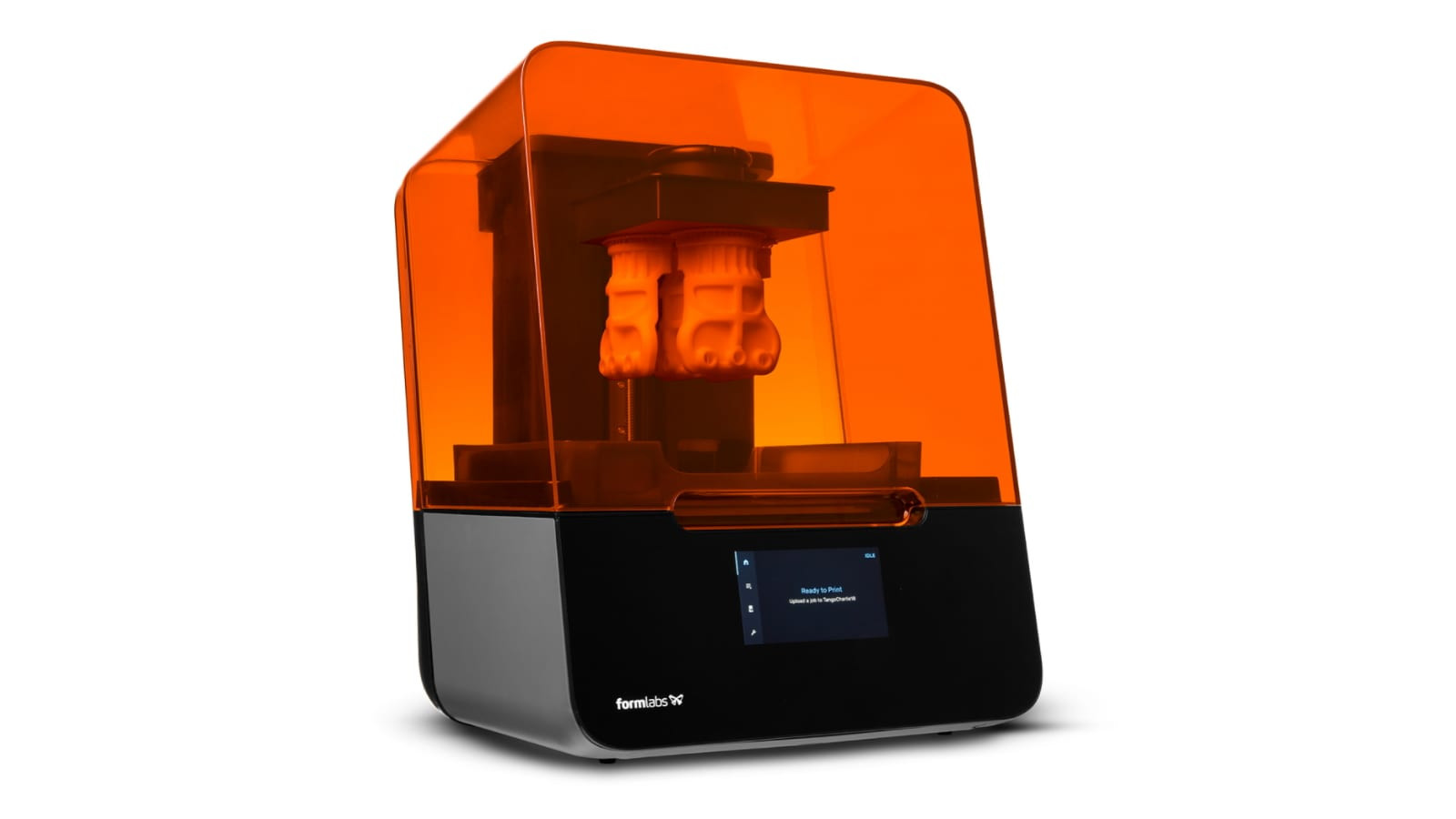
5. Form 3 — Formlabs

Formlabs Form 3 is the low-force stereolithography printer, described as the successor to the Form 2. A flexible film in the tank bottom lowers peel force. The light-processing unit moves along X so exposure stays even across the build. The listing says laser strength and XY resolution improved versus the Form 2, and that supports come out smaller and cleaner. It does not print a micron value, a laser spot size, or a build volume. Uses named: dental models, surgical guides, retainers, splints, and clear aligners. Material compatibility “varies by Form 3 model.”
LFS, in the introduction, is the flexible tank plus a light unit that draws with a laser rather than a DLP projector. That is the distinction from the Pro95. It is not a license to copy the Pro95’s 95 microns onto the Form 3.
Who it is for: Models, guides, splints, and aligners when you want Formlabs’ moving light unit and flexible tank, and you will take XY resolution from the current Form 3 sheet rather than from “enhanced.”
Tradeoff: Versus-Form-2 is not versus-Pro95. Smaller supports are not a measured support diameter. Resins that vary by model mean a Form 3 you already own may not match a resin this page never names. A flexible film wears; the listing does not give a tank life.
Frequently Asked Questions
Which technologies are actually on this list?
DLP for the Pro95, and DLP plus a laser sentence for the SolFlex 170. PolyJet for the Objet260. Fused deposition for the R.Pod. Low-force stereolithography for the Form 3. The introduction also defines plain SLA and FDM in general. Those definitions are the glossary. They are not extra printers.
Can I compare accuracy with one number?
Only the Pro95 prints a feature size: 95 microns. The Form 3 says XY resolution is better than the Form 2 and gives no number. The SolFlex, Objet260, and R.Pod print neither a micron nor a build volume. The 40 percent time cut on the SolFlex has no baseline.
Do these replace alginate?
They replace a model you would have poured only if a digital file already exists. This page does not include the scanner. If you are still taking a physical impression, the alginate choice is unchanged. A printer also does not sterilize the part it prints.
Is the R.Pod the same decision as a denture acrylic?
No. The R.Pod section is Valplast nylon filament for a flexible partial. The acrylic resins list is a different material and a different process. The other four printers here are resin or PolyJet model machines, not that nylon partial.
Read next
The impression and the denture material these printers get confused with:
Related articles
Keep exploring related topics from Dental Country.
Top 10 Hand Waxing Instruments in Dentistry
Compare PK Thomas, LeCron, Roach, Akers, and TiN wax carvers for crown, partial, and denture wax-ups.
Read article
Top 10 Amalgamators & Parts for Dentistry
Compare capsule mixers and parts — Silamat S6, RotoMix, Ultramat 2, GC CM-II — by timer, motion, and use.
Read article
Top 10 Bottle Cleaners for Dentists
Compare the best Bottle Cleaners for Dentists — our researched Top 10 ranking of the leading brands and options to help you choose the right fit for your practice.
Read article
7 Dental Websites to be Inspired by
Compare the best 7 Dental Websites to be Inspired by, ranked on performance, features, and value to help you choose the right fit for your practice.
Read article