
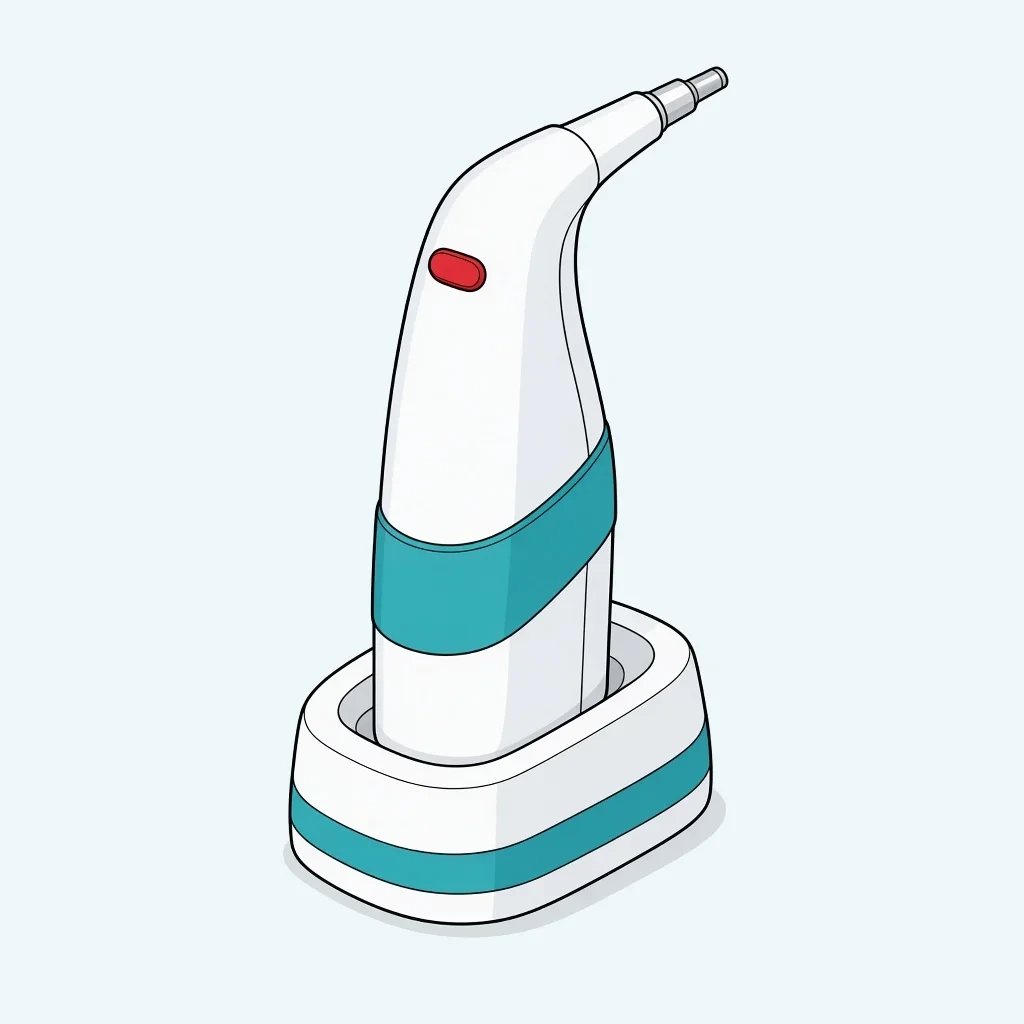
Intraoral Scanners: TRIOS, iTero, Primescan, Medit
Intraoral scanners for digital impressions: open STL files, Invisalign, carts, and how TRIOS, iTero, Primescan, Medit, and Planmeca differ.

Reviewed by Dr. Sean Myran, DMDDoctor of Dental Medicine, University of Pennsylvania
How we rank explains how these product lists are ordered.
An intraoral scanner records a 3D surface of the teeth for crowns, bridges, aligners, dentures, and implant planning. It is not an intraoral camera, and it is not the phosphor-plate reader some older pages call a scanner. Those plate readers digitize a radiograph. This guide is about optical impressions.
How to choose an intraoral scanner
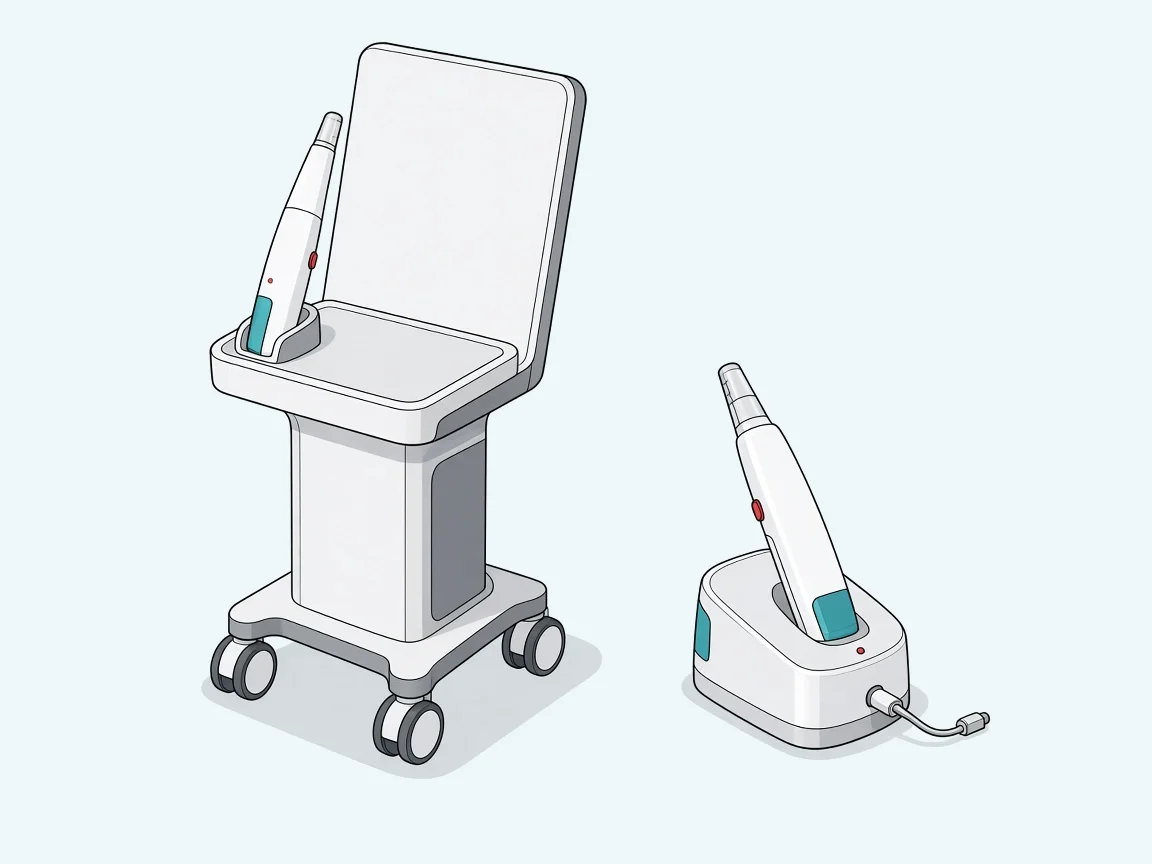
- Where the file has to go. An open scanner exports STL or PLY to the lab you already use. iTero is built around Align and Invisalign. Primescan is built around CEREC and a Sirona mill. Buy the path your cases actually travel.
- Cart, laptop, or wireless wand. A cart is stable and takes floor space. A laptop pod moves between rooms. A wireless wand removes the cable and adds a battery. Try a full-arch scan in the smallest operatory you have.
- Subscription. Some brands charge yearly software, cloud storage, or caries-detection features. Ask for the five-year cost, not the wand price on the proposal’s first page.
- What you scan. Full arches, edentulous ridges, implant scan bodies, and deep preps are different tests. A scanner that flies through a single crown prep can still struggle on a full denture impression.
- Who scans. If assistants scan, the wand weight, the heater, and the on-screen guidance matter more than a spec-sheet accuracy number you cannot verify in the office.
How the major scanners differ
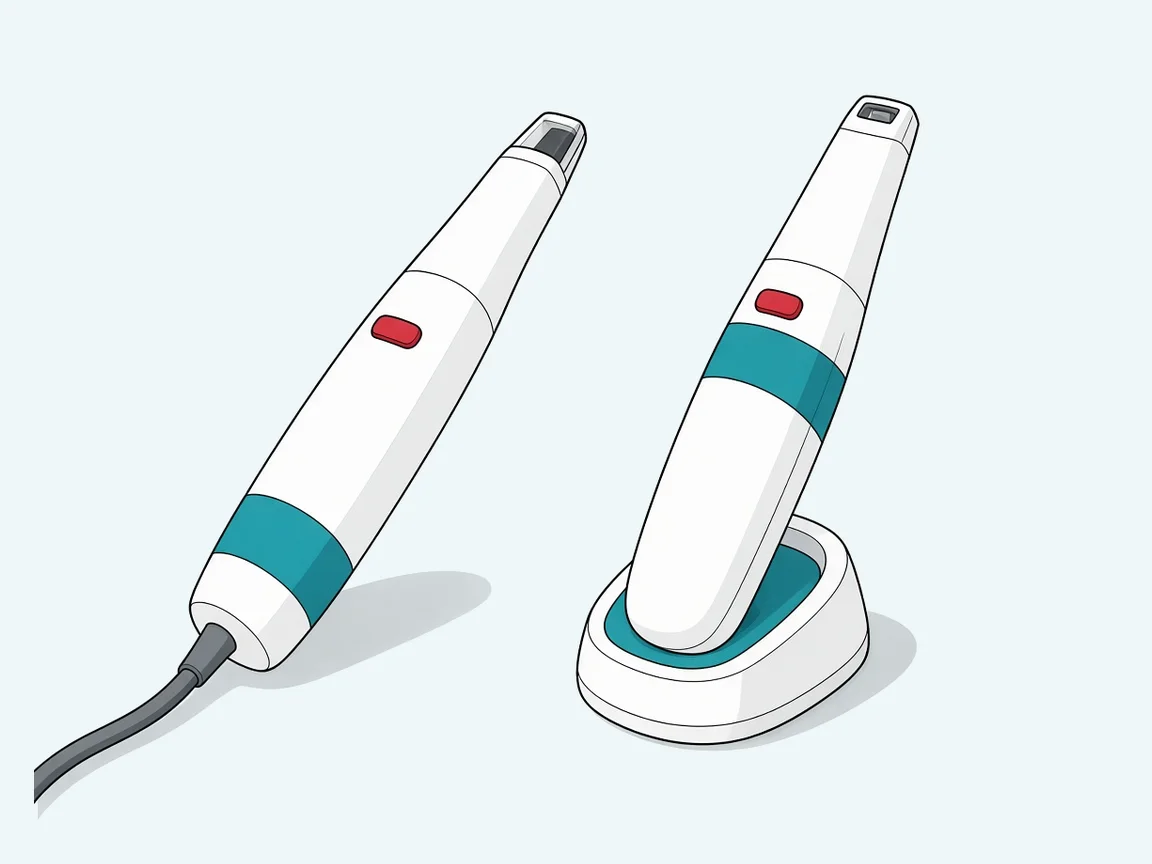
| Brand | Known for | Best fit | Watch for |
|---|---|---|---|
| 3Shape TRIOS | Open export and a broad lab network | Offices that send STL files to more than one lab | Software tiers and apps are part of the ongoing cost |
| Align iTero | Invisalign and the Align workflow | Practices that submit a lot of Invisalign | Weaker reason to buy if you rarely do Align cases |
| Dentsply Sirona Primescan | CEREC chairside and Connect lab cases | Offices milling same-day restorations on a Sirona mill | You are buying a workflow, not only a wand |
| Medit | Open files at a lower acquisition cost | Offices that want STL output without a premium cart | Confirm the lab will accept the export without a conversion step |
| Planmeca Emerald | Scanning inside a Planmeca CAD/CAM and imaging setup | Offices already on Planmeca mills or Romexis | Less reason to choose it as a standalone wand |
3Shape TRIOS
TRIOS is the scanner offices pick when the lab relationship is “send a file,” not “stay inside one manufacturer.” Models differ by wired versus wireless and by which software apps are included. Caries-detection tools on later TRIOS wands are an add-on decision, not the reason to buy the scanner.
Align iTero
iTero is the practical choice when a large share of scans are Invisalign submissions. The wand, the Invisalign case pipeline, and Align’s ecosystem are the product. If those cases are rare in your office, you are paying for a path you will not walk, and an open scanner is the cleaner buy.
Dentsply Sirona Primescan
Primescan replaced Omnicam as Sirona’s chairside scanner. It makes the most sense next to a CEREC mill, where the same visit can go from scan to design to mill. If a lab makes your crowns, compare Primescan’s lab-connect fee with simply emailing an STL from TRIOS or Medit.
Medit
Medit scanners are the open, lower-cost wands that pushed premium brands to justify their subscriptions. The buying test is mundane: scan a deep margin, export the file, and have your lab open it. If that works, the rest is wand feel and the software renewal.
Planmeca Emerald
Emerald fits when the office already uses Planmeca for imaging or milling and wants the scan in that same environment. As a lone scanner in a practice that uses someone else’s mill and someone else’s lab portal, it has fewer advantages.
Published specifications
These figures are copied from the manufacturer page for one current model in each line this guide already covers. A blank cell is a specification that page did not state. This is not a ranking, and a trueness number from a brochure is not included.
| Model | Connection | Weight | Files | Other stated spec |
|---|---|---|---|---|
| 3Shape TRIOS 5 | Wireless | 299 g, including the battery | PLY, DCM, and STL | 3.8 × 3.7 × 26.6 cm. Pod or MOVE+ cart. 3Shape’s TRIOS 5 specifications |
| Align iTero Lumina | Cart, mobile, or PC | 260 g | Align’s comparison page lists open STL and PLY export for the iTero scanners on that page | Wand 248.2 × 43.9 × 39.2 mm. Maximum capture distance listed as 25 mm |
| Dentsply Sirona Primescan | Acquisition Center cart. This is the scanner the sections above describe, not Primescan 2 | 457 g with the plastic sleeve; 524.5 g with the metal sleeve | 50.9 × 58.8 × 253 mm. Dynamic depth scan up to 20 mm. Dentsply Sirona chairside brochure | |
| Medit i900 | USB 3.1 Gen1 | 165 g, including the medium tip | 223.4 × 36.7 × 35.3 mm with the tip. Medit’s comparison chart lists 150 autoclave cycles for the reusable tip | |
| Planmeca Emerald S | USB | 229 g with the tip on the technical specifications page. The user manual lists 339 g with the tip and cable | STL and PLY | Two autoclavable tips, Standard and SlimLine |
Primescan 2 is a later wireless scanner. Dentsply Sirona says it requires a paid DS Core subscription and does not need a dedicated computer. Those facts stay off the Primescan row. The CAD/CAM and lab hub is the category page for this scanner and for the mill that may sit next to it.
Buying checklist
- File path. Export a scan and have the lab you use open it. STL or PLY is the open path. An iTero is the Align path. A Primescan is the CEREC and Connect path.
- The hard scan. Scan a deep margin and an edentulous span in the smallest operatory, with the person who will scan every day. A published weight does not tell you that.
- Wand versus cart. TRIOS 5 is wireless. Emerald S and Medit i900, in the wired configuration above, are USB. iTero Lumina is offered as a cart, a mobile setup, or a PC. Confirm which of those is on the quote.
- Subscription. Ask what the software, cloud storage, and any caries-detection feature cost over five years. The wand price on the first page is not that number.
- The tip that enters the mouth. TRIOS 5, Emerald S, and Medit publish an autoclavable tip or a closed tip with a sleeve. Read the reprocessing instructions before you buy. The CDC says a reusable device without reprocessing instructions may not be suitable for more than one patient.
- Case mix. The reviews in the next section support scanning for short-span fixed work more clearly than for full-arch removable prostheses. Buy for the cases you do.
Related guides
- CAD/CAM and lab equipment
- Milling machines
- Impression materials
- Intraoral cameras, which are not scanners
What the reviews actually compared
A 2023 umbrella review in Dentistry Journal pooled 23 systematic reviews of intraoral scanners against conventional impressions made with high-precision materials. On accuracy, the reviews disagreed, especially for full-arch work. The digital impression was favored for time and for patient preference. The authors also say high-quality evidence for conventional versus digital implant impressions is limited, that the scanners in the underlying studies are not the same devices, and that the number of missing teeth or implants is not the same from study to study. A published trueness number from one scanner, on one model, is not a number for the scanner on the quote.
A 2022 rapid umbrella review in the Journal of Evidence-Based Dental Practice looked at reviews from 2019 to 2021. Most of those reviews found intraoral scanning as precise and as accurate as a conventional impression. One review significantly favored the conventional impression, and two did not make a recommendation. Scanning was significantly better for patient preference and for time. On clinical data, the review says the same accuracy showed up for fixed dental prostheses of fewer than four units. For more extensive definitive fixed work, or for removable prostheses, that review recommends the conventional impression. It also says more clinical trials are needed.
Those two reviews are why a scanner purchase is a case-mix decision. A practice that does single crowns and short-span bridges is reading a different evidence sentence from a practice that does full-arch implant bridges or removable prostheses. The scanner still has to be reprocessed on its manufacturer’s instructions. The CDC says a reusable device without reprocessing instructions may not be suitable for more than one patient, and a scanner head that enters the mouth is a patient-contact device.
Scanner questions
Do I need a scanner if my lab still pours models?
Only if you want to stop taking physical impressions. The lab can still print a model from an open scan. If every case is a triple tray and you like it that way, a scanner will sit.
What accuracy number should I trust?
None that you did not produce. Published trueness figures come from the manufacturer’s protocol. Scan a prep with a deep margin in your light, with your assistant, and send it to your lab. That is the accuracy you will live with.
Do the reviews say a scanner matches a conventional impression for every case?
No. The 2023 umbrella review found conflicting accuracy results, especially for full-arch work. The 2022 review says clinical data support scanning for fixed prostheses under four units, and it recommends a conventional impression for more extensive definitive fixed work and for removable prostheses.
Sources
Conventional versus Digital Dental Impression Techniques: What Is the Future? An Umbrella Review. Dentistry Journal. 2023;5(3):60.
Accuracy of intraoral scanners versus traditional impressions: a rapid umbrella review. Journal of Evidence-Based Dental Practice. 2022.
Centers for Disease Control and Prevention
Sterilization and Disinfection. Dental Infection Prevention and Control.
Updated May 15, 2024cdc.gov (opens in a new tab)3Shape
TRIOS 5 wireless intraoral scanner, technical specifications.
Align Technology
iTero intraoral scanner comparison.
Dentsply Sirona
CEREC Primescan chairside brochure.
Dentsply Sirona
Primescan 2.
Medit
Intraoral scanner specifications.
Medit
Scanner comparison.
Planmeca
Emerald S technical specifications.
Planmeca
Emerald S user manual.
Related articles
Keep exploring related topics from Dental Country.
Porcelain Brushes for the Dental Lab: Sable vs Kolinsky
Kolinsky, red sable, and synthetic porcelain brushes for build-up, stain, and glaze at the lab bench.
Read article
Denture Separators and Liquid Foil: COE-SEP and More
Denture separators: tin-foil substitutes, trial-pack film, real foil, and a debubblizer that is not one.
Read article
Dental 3D Printers: SprintRay, Formlabs, Stratasys
Dental 3D printers matched to indication, and how SprintRay, Formlabs, VOCO, Stratasys, and Arfona differ.
Read article
Dental Milling Machines: Primemill, PlanMill, PrograMill
Chairside blocks versus lab discs, and how the CEREC, PlanMill, PrograMill, Ceramill, and Roland milling machines differ.
Read article