
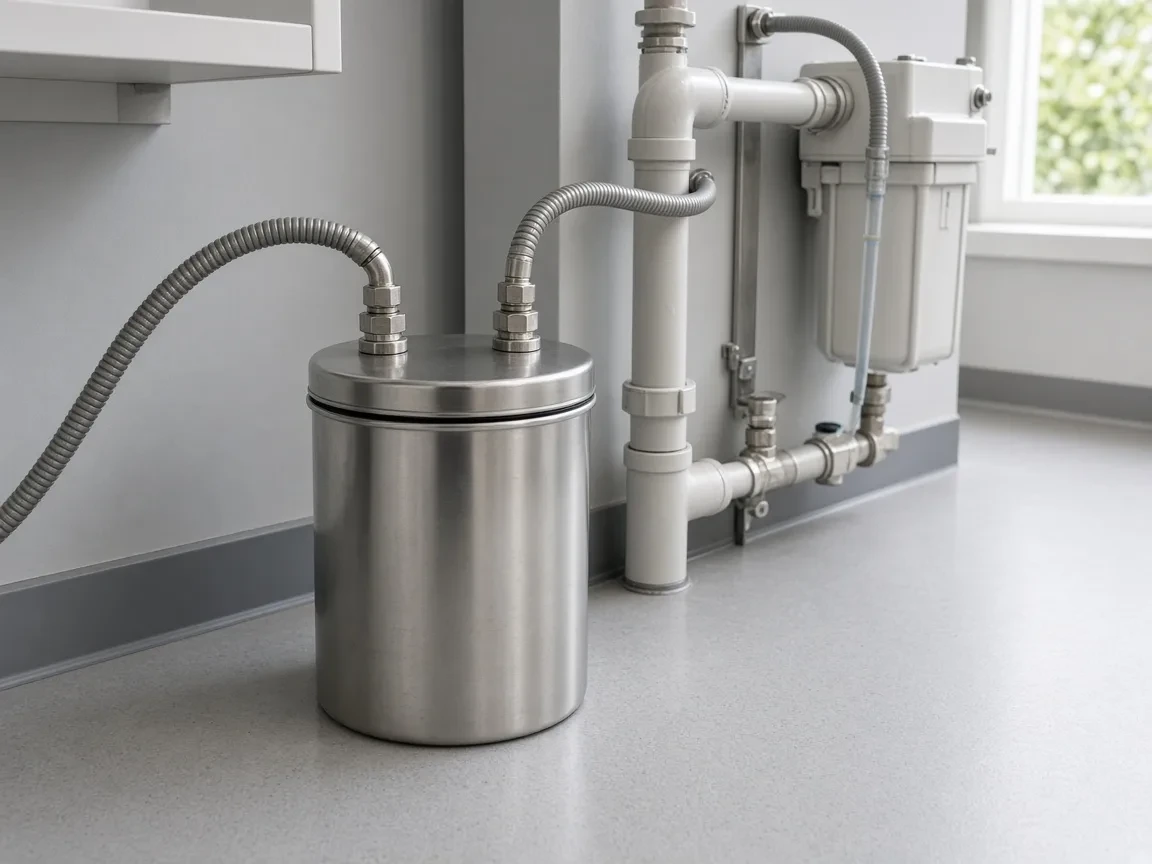
Dental Amalgam Separators: How to Choose.
How to choose an amalgam separator: central or chairside, canister recycling, and how Solmetex, Rebec, Dürr, and Metasys differ.

Reviewed by Dr. Sean Myran, DMDDoctor of Dental Medicine, University of Pennsylvania
How we rank explains how these product lists are ordered.
An amalgam separator catches amalgam particles before office wastewater leaves the building. It is not the vacuum pump, and it is not the trap under the chair. The vacuum guide is the pump. The evacuation product list is the saliva ejector, the HVE valve, and the chairside trap.
How to choose an amalgam separator
- Central or chairside. One canister on the vacuum line serves the whole office and is one container to change. A unit at each chair means a canister in every room and plumbing at the chair. Pick the layout the installer can actually reach.
- On the waste path, not beside the pump as a decoration. The separator has to sit where that model’s diagram puts it. A dry vacuum still needs liquids kept out of the pump. The separator does not replace that air-and-water separation. Read the vacuum guide before you treat one canister as the whole mechanical room.
- Ask for ISO 11143. That is the rating the U.S. dental wastewater rule points to. This page is the equipment choice, not a permit review. An office that does not place or remove amalgam may be able to certify that. Ask the installer and the local sewer agency. Do not decide it from a buying guide.
- The full canister is recycled. It goes back through the program the manufacturer or the dealer runs. It does not go in the trash, and it does not go in the sharps container. The quote should name who picks up the full container.
- Size it the way you size the pump. Use the number of operatories on that vacuum line, not the number of chairs in the building that sit idle. A separator rated for fewer rooms than you run will fill early and can back the line up.
How common separator lines differ
Treat the table as product differences, not a score. No canister volume is printed here. Read the model plate for the number of rooms that unit is rated for.
| Line | Known for | Best fit | Watch for |
|---|---|---|---|
| Solmetex | Canister separators installed on many U.S. vacuum lines, including the Hg5 | A central canister added to a vacuum that is already in the mechanical room | The replacement canister is the ongoing service. Confirm the new unit takes the canister you will actually recycle |
| Rebec | Separators sold for both central and chairside installs | An office that is still deciding whether the canister lives in one room or in each operatory | Chairside means more canisters. Central means the vacuum line has to reach one unit |
| Dürr | Central separators paired with Dürr suction | An office already on a Dürr vacuum, or quoting both together | Follow Dürr’s diagram. A canister from another brand on the pump inlet is not the same install |
| Metasys | Central collectors, including centrifuge-style units | Offices comparing a collector with a simple canister | Service is the collection container. Do not rinse the sludge in the sink |
Solmetex
Solmetex is the canister line many U.S. offices already have on the vacuum line. The Hg5 is the model installers name first. Buy it when you want one central canister and a recycling program for the full container. Confirm the replacement canister matches that model. A canister from a different generation can look similar and not fit the head you just mounted.
Rebec
Rebec sells separators for a central mechanical room and for the individual chair. The choice is the number of containers you will change, not a brochure photo of a stainless can. A chairside unit still has to connect to the vacuum waste from that room. A central unit still has to be downstream of the chairs and upstream of the point the manufacturer specifies.
Dürr
Dürr’s separator belongs with Dürr suction. Quote it when the vacuum is already Dürr, or when you are buying the vacuum and the separator as one mechanical-room package. The vacuum guide covers the pump. This page only covers the amalgam device. Do not hang a different brand’s canister on the inlet because the hose happened to fit.
Metasys
Metasys is the central collector offices compare with a plain canister, including units that spin the waste instead of only settling it. The sludge still has to leave the building through a recycler. Rinsing the container into a sink undoes the reason you bought the separator. Confirm the service kit and who ships the full container before you prefer it over a Solmetex-style canister.
Related guides
Separator questions
Is the chairside trap enough?
No. The trap under the cuspidor or in the HVE line catches debris at the chair. The separator is the device on the waste line that the wastewater rule is written around. Keep the trap. Add the separator.
Does a new dry vacuum include amalgam separation?
Not by default. A dry pump needs liquids removed before the air reaches it. That air-and-water separation is not the same part as an amalgam separator. Ask for both on the quote if you place or remove amalgam.
Related articles
Keep exploring related topics from Dental Country.
Top 10 Alginate Impression Material for Dentists
Alginate compared by cue: chromatic phases, Jeltrate Plus antimicrobial, AccuDent XD’s two viscosities, Hydrogum 5’s five-day stability.
Read article
Top 10 Rubber Dam Clamps for Root Canals
Compare winged, wingless, Brinker, and serrated rubber dam clamps from Hu-Friedy, Coltene, and Kulzer for root-canal isolation.
Read article
Dental Instrument Washers: How to Choose
How to choose a dental instrument washer: cassette capacity, drying, and how SciCan HYDRIM, Melag, and Miele differ.
Read article
Dental Operator Stools: How to Choose
How to choose a dental stool: doctor versus assistant, seat height, and how A-dec, Midmark, Brewer, and Crown Seating differ.
Read article