
Dental Bridge Vs Implant: Which Is Better?
A dental bridge and implant solve missing teeth differently. Compare surgery, timeline, neighboring teeth, cleaning, bone needs, cost, and repairs.

Reviewed by Dr. Sean Myran, DMDDoctor of Dental Medicine, University of Pennsylvania
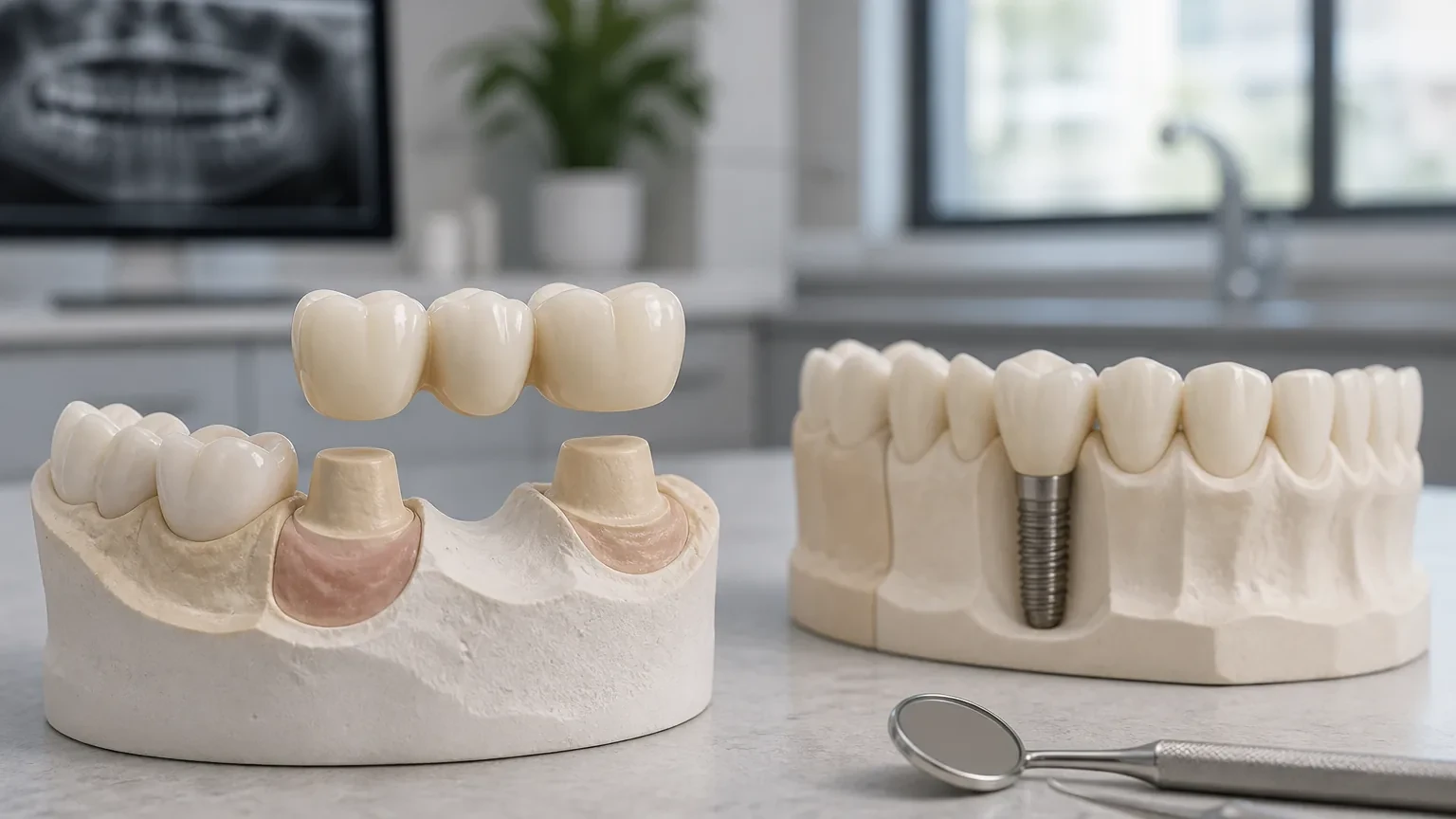
Neither a dental bridge nor a dental implant is better for every missing tooth. A bridge fills a gap by attaching to neighboring teeth or implants. An implant replaces the tooth root with a surgical post and later supports a crown. MouthHealthy describes bridges as artificial teeth anchored to nearby teeth or implants. The better option depends on bone, adjacent teeth, health history, timeline, cost, and how you can clean the result.
Bridge And Implant Compared
| Factor | Dental Bridge | Dental Implant |
|---|---|---|
| Neighboring teeth | Often reshaped for crowns | Usually left untouched |
| Surgery | Usually no implant surgery for a traditional bridge | Requires surgical placement and healing |
| Timeline | Often faster | Often longer, especially with grafting |
| Cleaning | Needs cleaning under a connected pontic | Cleaned more like a single tooth, with implant-specific tools |
| Bone needs | Less dependent on bone volume at the gap | Needs enough healthy bone or grafting |
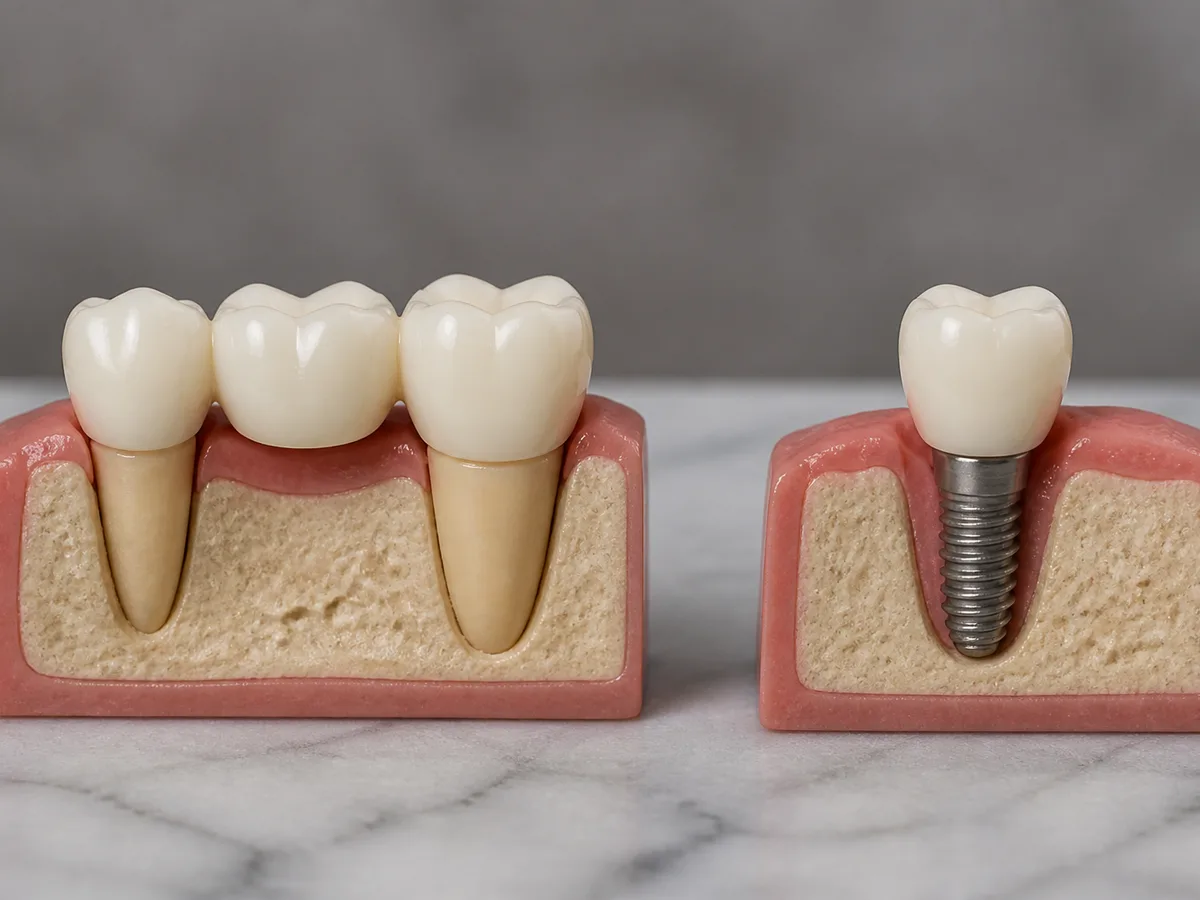 The gap is not the only patient.
The nearby teeth can decide
If the teeth beside the gap already need crowns, a bridge may solve several problems together. If those teeth are untouched and strong, preserving them may make an implant more appealing when health and bone allow.
When A Bridge Makes More Sense
A bridge may be favored when the neighboring teeth need crowns anyway, implant surgery is not a good fit, bone grafting would add too much time or cost, or the patient wants a fixed option sooner. It can also be useful when the bite, smile line, or gum shape makes an implant result less predictable. The main tradeoff is that the support teeth become part of one connected restoration.
An implant may be favored when the adjacent teeth are healthy, there is enough bone, the patient can tolerate surgery, and a longer timeline is acceptable. Implants do not get cavities, but the gum and bone around them can still become inflamed. They also need careful planning around medical conditions, smoking, diabetes control, grinding, and the position of nerves or sinuses.
Cost comparisons should include every stage. A bridge estimate may include preparation, temporary bridge, final bridge, and possible buildups. An implant estimate may include extraction, grafting, implant placement, abutment, crown, imaging, and follow-up. The lower first number is not always the lower lifetime cost.
Age alone does not decide the answer. A healthy older adult with good bone and stable medical conditions may be an implant candidate. A younger patient with uncontrolled gum disease, heavy smoking, or poor bone may need a different sequence first. The condition of the support teeth can outweigh assumptions about age, and so can a person's ability to maintain the restoration. The best comparison is made from an exam, X-rays or 3-D imaging when needed, and a frank discussion of healing time.
Also ask how each choice affects future options if it fails. Repair paths can matter as much as the first replacement.
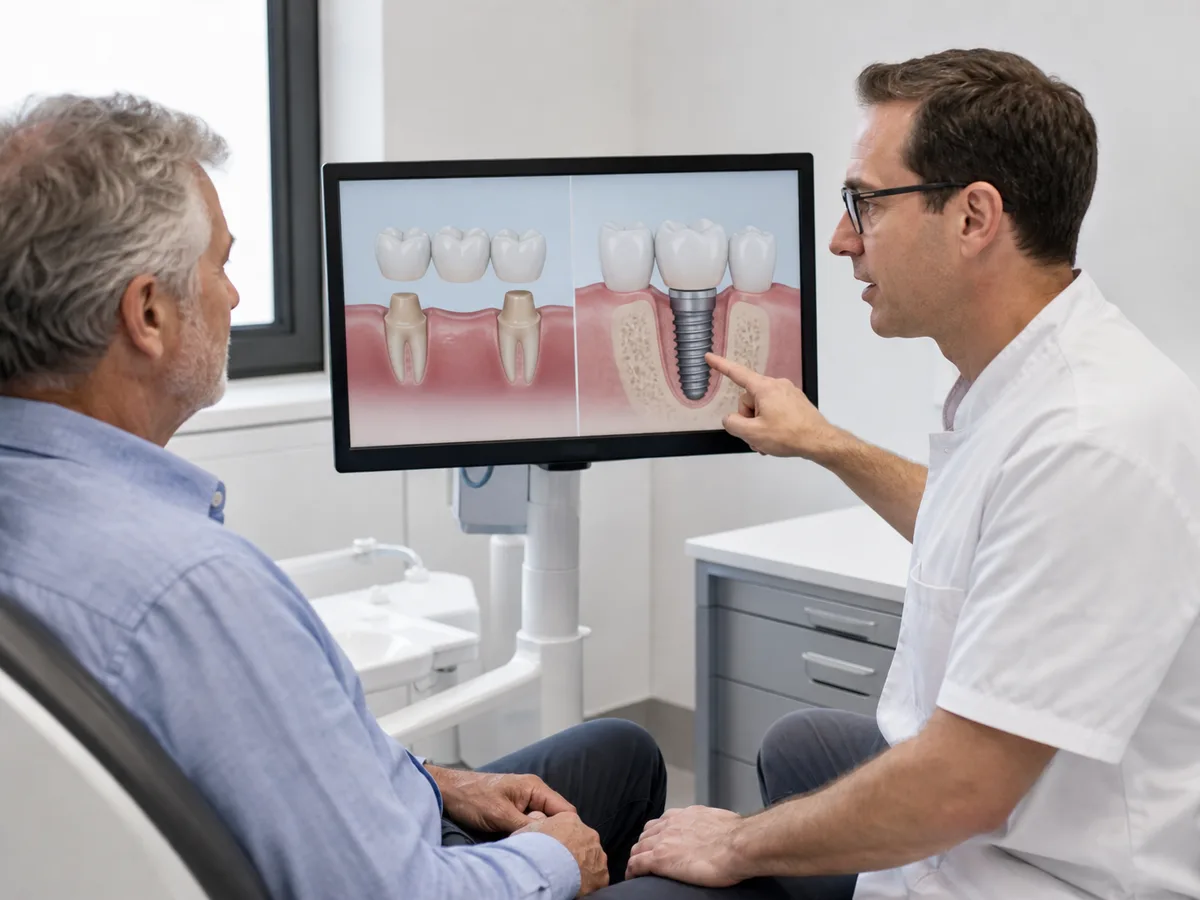 A clear estimate separates each phase.
Compare the whole sequence
Ask for written options with the number of visits, healing time, cleaning tools, and likely future repairs. Use find a dentist if you want a restorative or implant consult for a specific missing tooth space.
How To Choose Without Guessing
Ask whether the support teeth are healthy enough for a bridge, whether bone is adequate for an implant, and what each option means if something fails later. A bridge problem can involve multiple units. An implant crown problem may be more isolated, but implant complications can be harder to reverse. For bridge basics, start with What Is A Dental Bridge?; for crown cost context, see How Much Does A Dental Crown Cost?.
Related articles
Keep exploring related topics from Dental Country.
When Do You Need A Dental Crown?
A crown recommendation usually means the tooth needs reinforcement, not just a patch. The deciding clues are cracks, walls, bite, and remaining enamel.
Read article
How Long Do Dental Crowns Last?
Crown lifespan is not a fixed warranty. The tooth underneath, the bite around it, and the edge where plaque collects decide much of the outcome.
Read article
Crown Vs Filling: How Do Dentists Decide?
A filling replaces missing tooth. A crown protects what is left. The right choice depends on structure, cracks, bite, and how much tooth remains.
Read article
What Is A Dental Bridge?
A dental bridge fills a tooth gap with an artificial tooth supported by neighboring teeth or implants, but the anchors and cleaning plan matter.
Read article