Home › Lists › Top 5 Milling Machines (CAD/CAM) in Dentistry
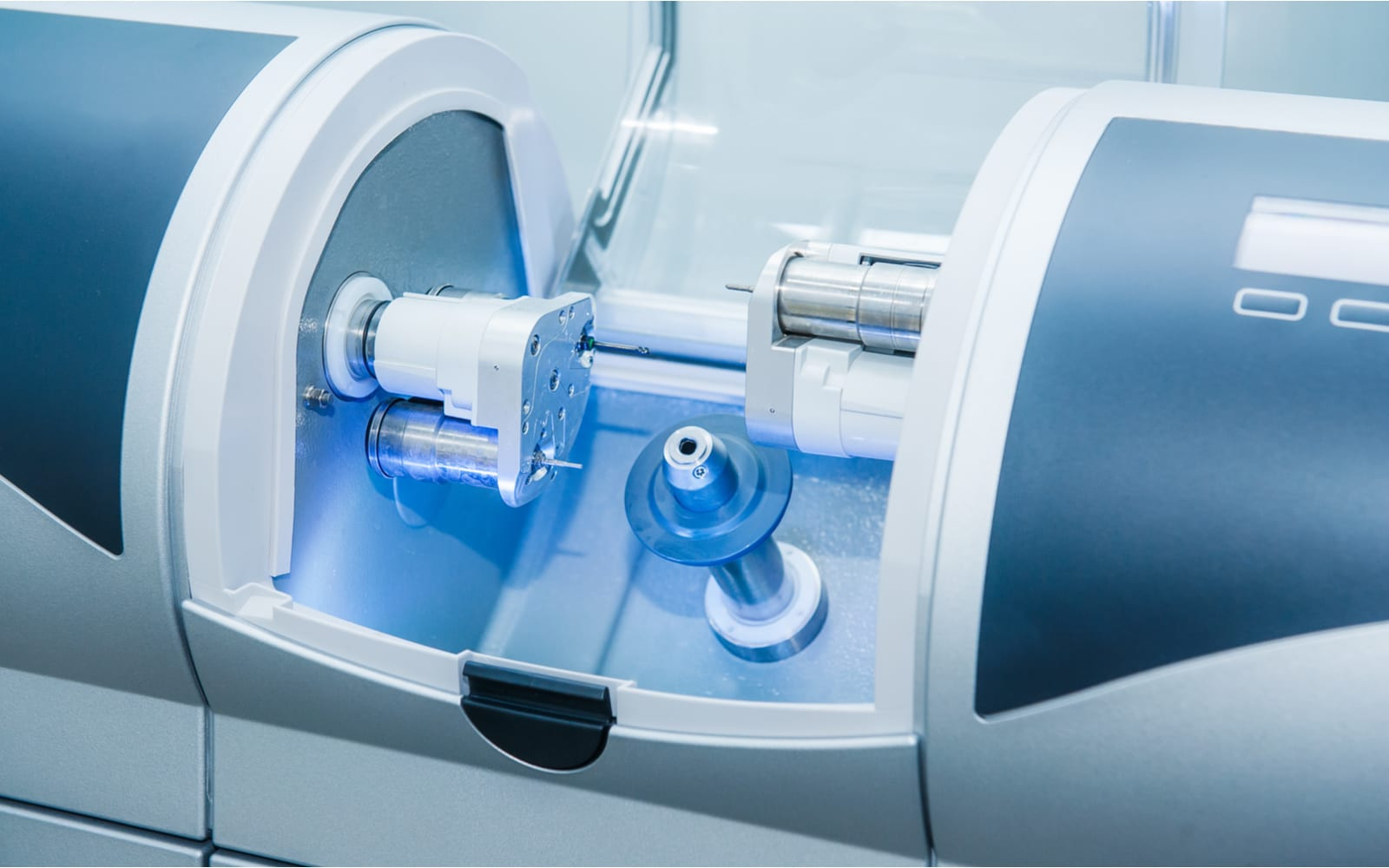
The best dental milling machines of 2026 for chairside CAD/CAM are CEREC (Dentsply Sirona) and Planmill; for in-house lab use, Roland DWX, vhf S-series, Amann Girrbach Ceramill, and IMES-iCORE lead the market. Choice depends on whether you mill wet (glass-ceramic) or dry (zirconia), 4-axis vs. 5-axis capability, and chairside vs. lab workflow.
Dental Milling Machine Comparison Machine Type Axes Best For Price Tier
CEREC Primemill Wet 4-axis Chairside same-day crowns Premium ($$$$)
Planmill 40 S Wet 4-axis Chairside Planmeca workflows Premium ($$$$)
Roland DWX-52DC Dry 5-axis In-house lab, zirconia & PMMA Mid-Premium ($$$)
vhf S2 Impression Wet/Dry 5-axis Lab full-arch zirconia Premium ($$$$)
Amann Girrbach Ceramill Matik Wet/Dry 5-axis Lab high-volume production Premium ($$$$)
IMES-iCORE 350i Pro Dry 5-axis Lab dry-only workflows Mid-Premium ($$$)
Aidite AMD-500DC Wet/Dry 5-axis Value lab milling Mid-Range ($$)
Compare top dental milling machines for chairside and in-house lab use. How to Choose a Dental Milling Machine Chairside vs. lab — Chairside units (CEREC, Planmill) prioritize speed for same-day crowns. Lab units (Roland, vhf, Amann) prioritize precision and material range.
Wet vs. dry vs. both — Wet for glass-ceramic (e.max, Empress). Dry for zirconia and PMMA. Combo units cost more but eliminate workflow bottlenecks.
4-axis vs. 5-axis — 5-axis is mandatory for full-arch bridges, complex angled abutments, and screw-retained implant bars.
Spindle quality & service — Spindle replacement is the largest ongoing cost. Premium German/Swiss machines have longer spindle life and better local service.
Software ecosystem — Verify the machine integrates with your CAD software (exocad, 3Shape) and that nesting/STL workflows are mature.
A simple guide to selecting a CAD/CAM milling machine CAD/CAM milling machines have only developed over the past few years, but today’s dental laboratories now feature various milling options. Even while the inner hardware of milling machines hasn’t changed, the dynamics of what they offer have and thus can make it difficult for dentists to choose features that will best support their practices. Tooling and milling strategies matter when choosing the right milling machine for your practice, but so does the machine itself. With the accuracy of today’s fabrication process, dental object printing has become a more potent, reliable source for restorations.
The Evolution of CAD/CAM Machines
CAD/CAM machines were originally developed in the 1960s for the aircraft and automobile industries. Still, it wasn’t until 1971 when Dr. Francosis Duret developed the first CAD/CAM machine for an abutment tooth and produced the first restoration for treatment in 1983. These CAD/CAM machines didn’t have digitization scanners and had to be manually operated to produce dental crowns , veneers, and other restorations. It wasn’t until 1987 when Mörmann and Brandestini discovered the CEREC system, which combined digital scanning with a milling unit to produce dental restorations.
All CAD/CAM machines contain three essential components:
Computerized Surface Scanners – Also referred to as the machine’s software, all geometric shapes are transformed into digital data using multiple scanning and digitization methods. The data acquired to transmute the information into a physical impression can be done through the following:
Optical Scanners – These types of scanners consist of a collection of three-dimensional structures operating in a triangulation procedure. The laser, acting as the light source, and the receptor are positioned at a definite angle to calculate a three-dimensional data set for the image. Some examples of these kinds of CAD/CAM machines are the ES1 and 3M ESPE Lava Scan ST.
Mechanical Scanners – Mechanical scanners use a master cast and ruby ball that reads mechanically line-by-line to create the three-dimensional structure. The diameter of the rubber ball is set to the smallest grinder in the milling system and produces a high scanning accuracy, milling all the data collected. However, mechanical scanners are more expensive, have more complicated mechanics, and have a longer processing time.
Design Software – The number of milling axes within the machine distinguishes the design software. The number of milling axes determines the degree of movement during the design process of the restoration and how many adjustments can be made during design.
3-axis milling – These milling machines operate in three spatial directions and are defined by the X-, Y-, and Z- values. These devices can turn the component by 180 degrees when processing the inside and outside of the data image. These machines produce shorter milling times, have more simplified controls, and are cost-effective.
See Great Dental Website Designs 4-axis milling – A 4-axis milling machine includes the three spatial axes and a tension bridge for turning infinitely. This gives the construction a larger vertical height displacement to save materials and milling time for creating mold dimensions.
5-axis milling – In addition to the three spatial axes and tension bridge, a milling spindle enables the milling of complex geometries within subsections of the mold design.
When it comes to processing methods for CAD/CAM systems, two classifications of milling processing determine the materials needed for the milling machine and the costs, including:
Dry Processing: Also called dry grinding or dry ball milling, dry milling uses pressurized air and a vacuum to remove material particles. Dry milling can use materials such as zirconia, polyester ether ketone, PMMA, and wax to develop prosthetics and restorations.
Wet Processing: A spray of cool liquid protects the milling diamond or carbide cutter to avoid damage due to heat. This process is necessary for metals, ceramics, and resins and typically produces a less grain-filled and more accurate restoration.
Depending on the company, each system has its own specifications and operating systems for milling machines. So, when searching for a wet or dry milling machine, please pay attention to what their digitization scanners operate on matters. Here are our suggestions for the top milling machines, their prices, and brief specifications on what they offer for your practice.
Ultimate Guide to Planmeca PlanMill 40 S Review
1. PrograMill PM7 by Ivoclar Vivadent Product Description The PrograMill PM7 is a powerful 5-axis milling unit designed for both dry and wet processing. Its hybrid capabilities, integrated touchscreen interface, and intelligent automation make it an advanced solution for efficient, high-quality dental restorations.
Product Overview Built for speed and precision, the PrograMill PM7 offers seamless fabrication through centralized control. It features synchronized material and tool changers, an internal PC with a user-friendly touchscreen, and an ionizer to minimize cleaning during PMMA processing. Its compatibility with a wide range of materials—including lithium disilicate and zirconia—makes it suitable for a variety of clinical and laboratory applications.
Key Features
5-axis simultaneous milling for complex geometries
Integrated PC with touchscreen monitor
Dry and wet material compatibility
Automatic tool and material changers for continuous workflow
Centralized control system for optimized milling strategies
Built-in ionizer reduces PMMA dust buildup and cleaning time
High-performance 970-watt spindle with servomotors
Supports lithium disilicate, PMMA, zirconia, and more
Common Applications
Milling of inlays, onlays, crowns, bridges
Frameworks and full-contour restorations
Provisional and long-term prosthetics
Implant-supported structures
CAD/CAM-based design and production workflows
Technical Specifications
Power Output: 970 watts
Axis Movement: 5-axis
Processing: Wet and dry
Interface: Integrated touchscreen PC
Automation: Automatic tool/material changers
Additional Feature: Built-in ionizer for PMMA dust reduction
Customer Feedback Users report excellent precision, reduced manual intervention, and smoother workflows. Many highlight its ability to handle diverse material types and complex cases with ease, making it a valuable asset in high-demand environments.
More Information
See Great Dental Website Designs 2. CEREC MC XL by Dentsply Sirona Product Description The CEREC MC XL is a high-performance chairside milling unit designed to produce a wide range of dental restorations with precision and efficiency. Its advanced technology enables dental professionals to fabricate restorations in a single visit, enhancing patient satisfaction and practice productivity.
Product Overview Equipped with four spindle motors, the CEREC MC XL can mill and grind various materials, including ceramics and composites. It supports the fabrication of inlays, onlays, crowns, veneers, bridges, abutments, and surgical guides. The unit’s intuitive touchscreen interface allows for easy operation and monitoring of the milling process.
Key Features
Four spindle motors for efficient milling and grinding
Compatible with a variety of materials, including ceramics and composites
Supports a wide range of restorations: inlays, onlays, crowns, veneers, bridges, abutments, and surgical guides
Intuitive touchscreen interface for easy operation
Fast milling times, with crowns produced in approximately 10 minutes
Integrated with CEREC software for seamless workflow
Common Applications
Single-visit restorations
Fabrication of crowns, inlays, onlays, and veneers
Production of bridges and implant abutments
Creation of surgical guides for implant procedures
Technical Specifications
Dimensions: 42 x 70 x 40 cm (16.53 x 27.56 x 15.75 inches)
Weight: 43 kg (95 pounds)
Power Requirements: 100V-230V, 50/60 Hz, 1.5 – 3.5 A
Milling Time: Approximately 10 minutes per unit
Material Block Size: Up to 85 x 40 x 22 mm
Number of Axes: 4
Automatic Tool Changing: No
Wet Grinding: Not supported
Customer Ratings Highly regarded for its speed, precision, and versatility, the CEREC MC XL is a popular choice among dental professionals seeking to enhance their practice’s capabilities.
Customer Feedback Users appreciate the unit’s ability to produce high-quality restorations quickly, reducing the need for multiple patient visits. The intuitive interface and seamless integration with CEREC software contribute to an efficient and user-friendly experience.
3. Planmeca PlanMill 30S by Planmeca
Product Description The Planmeca PlanMill 30S is a high-precision, chairside milling unit designed for efficient, same-day dental restorations. With a powerful single-spindle motor and a 4-axis milling system, it offers excellent performance across a wide range of materials and restoration types.
Product Overview Built for speed and reliability, the PlanMill 30S operates at up to 100,000 RPM and uses linear motor technology for precise rotary axis control. The unit features a five-position tool changer and an open platform design, allowing seamless integration with most dental systems. Its average milling time of 20–25 minutes makes it well-suited for both single-unit and complex restorations.
Key Features
Single-spindle motor with 4-axis simultaneous milling
High-speed performance with up to 100,000 RPM
Linear motor-driven rotary axis for precise control
Five-position automatic tool changer
Open platform for easy integration with third-party systems
Supports multiple material types: ceramic, composite, abutment blocks
Efficient milling time of 20–25 minutes
Designed for smooth chairside operation
Common Applications
Single and multi-unit crowns
Inlays, onlays, and veneers
Abutment and implant restorations
Aesthetic composite restorations
Custom-fit milling for various case types
Technical Specifications
Spindle Speed: Up to 100,000 RPM
Axes: 4-axis system
Tool Positions: 5
Milling Time: 20–25 minutes per restoration
Platform: Open system
Compatible Materials: Ceramic, composite, abutment materials
Customer Ratings Well-reviewed for its accuracy, system flexibility, and ease of use in high-demand practices offering same-day restorations.
Customer Feedback Dentists value the machine’s open integration and ability to work with a wide range of restorative materials. Its speed, precision, and reliability are frequently mentioned as top strengths for busy clinical environments.
4. Ceramill Mikro IC by Amann Girrbach Product Description The Ceramill Mikro IC is a compact yet high-performance 4-axis milling unit designed for wet grinding of complex dental restorations. Engineered with advanced DNA milling strategies, it delivers exceptional precision and durability, making it ideal for handling demanding materials like glass ceramics and titanium.
Product Overview Optimized for speed and accuracy, the Ceramill Mikro IC features an 8-position automatic tool changer and a 750-watt motor. It includes a carving mode that reduces processing time by up to 60%, while its thrilling mode enables the precise adaptation of standard CAD blocks into block assemblies. Its sturdy build and wet processing capability ensure consistent results for both simple and advanced milling cases.
Key Features
4-axis wet milling with high precision and minimal vibration
DNA milling strategies for efficient and accurate material removal
8-position automatic tool changer
750-watt motor for robust cutting performance
Carving mode for up to 60% faster processing
Thrilling mode for converting standard CAD blocks into assemblies
Designed for hard materials like titanium and glass ceramics
Compact, space-saving footprint with high reliability
Common Applications
Inlays, onlays, and full-contour crowns
Bridges and veneers
Titanium and glass ceramic restorations
Precision milling of complex prosthetic components
Block adaptation for advanced restorative work
Technical Specifications
Milling Type: Wet
Axes: 4-axis system
Power Output: 750 watts
Tool Changer: 8-position automatic
Carving Mode: Yes, up to 60% time reduction
Thrilling Mode: Yes, for block assembly adaptation
Compatible Materials: Titanium, glass ceramics, and other hard materials
Customer Ratings Recognized for its compact power, milling speed, and ability to process high-strength materials with precision.
Customer Feedback Users appreciate its advanced milling modes, easy material handling, and strong cutting capability. The carving and thrilling modes are especially praised for saving time and expanding restoration possibilities.
See Great Dental Website Designs 5. DWX-4W Wet Dental Mill – Roland Product Description The DWX-4W is a compact 4-axis wet milling machine engineered for high-precision fabrication of glass ceramic and composite resin restorations. Ideal for small labs or chairside use, it delivers consistent milling performance with user-friendly operation and minimal maintenance.
Product Overview Built to handle daily restorative demands, the DWX-4W includes ball screw-driven control, multi-pin clamps for simultaneous milling, and an automatic tool changer. With a maximum spindle speed of 60,000 RPM, it efficiently produces crowns, inlays, and bridges while maintaining tight tolerances. The system supports one-button operation and can deliver restorations for up to three patients per day without interruption.
Key Features
4-axis wet milling for glass ceramics and composite resins
Ball screw-driven axis for precision and durability
Multi-pin clamp system for simultaneous milling
Automatic tool changer for uninterrupted production
One-button operation for ease of use
High-speed spindle up to 60,000 RPM
Compact and quiet design suitable for clinical environments
Common Applications
Crowns and inlays
Onlays and veneers
Three-unit bridges
Same-day restorations in ceramic and resin materials
Technical Specifications
Milling Type: Wet
Axes: 4-axis system
Spindle Speed: Up to 60,000 RPM
Tool Changer: Automatic
Material Compatibility: Glass ceramic and composite resin
Operation: One-button control
Patient Capacity: Up to 3 patients/day without interruption
Customer Ratings Appreciated for its precision, simplicity, and space-saving design, the DWX-4W is a top choice for smaller practices and labs focused on high-quality, in-house milling.
Customer Feedback Users commend the DWX-4W for its reliability, intuitive operation, and the ability to produce multiple restorations in a single day. Its clean, quiet performance and consistent output make it a popular choice for chairside restorative workflows.
Dental Milling Machine FAQ What is the best dental milling machine? For chairside dentistry, CEREC Primemill is the most established choice. For in-house lab milling, Roland DWX-52DC (mid-range) and vhf S2 or Amann Girrbach Ceramill Matik (premium) are top picks based on accuracy, material range, and service support.
How much does a dental milling machine cost? Dental milling machines range from about $25,000 for value 5-axis dry mills (Aidite, some Asian imports) to $150,000+ for premium 5-axis wet/dry production units like Amann Girrbach Ceramill Matik or vhf S2 Impression.
What is a 5-axis dental milling machine? A 5-axis dental milling machine moves cutting tools along five independent axes — three linear (X, Y, Z) plus two rotational — letting it mill complex undercuts, angled implant abutments, and full-arch bridges in one setup. 4-axis machines are limited to simpler crown geometries.
Is chairside CAD/CAM worth it? Chairside CAD/CAM pays back when you mill 3–5+ crowns per week. Same-day delivery improves patient experience, eliminates temporary crown remakes, and captures restorative work that would otherwise go to outside labs.
What can a dental milling machine make? Dental milling machines fabricate crowns, bridges, inlays, onlays, veneers, partial denture frameworks, surgical guides, custom abutments, full-arch zirconia prosthetics, and night guards — depending on the machine’s axes and material compatibility.
Related Reading: Top 10 Dental CAD/CAM Milling Burs | Top 10 CAD/CAM Porcelain Blocks