
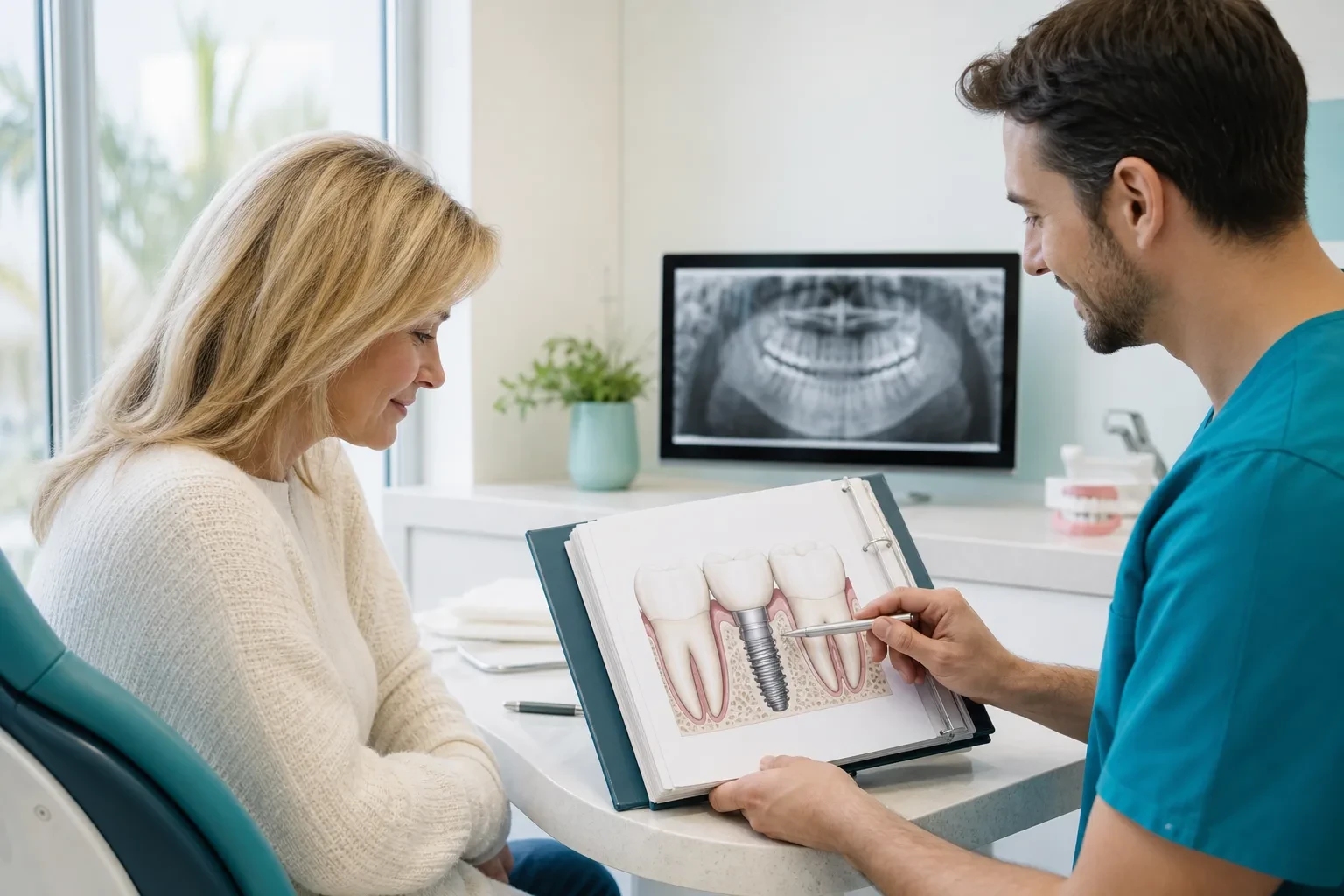
Dental Implants: Complete Patient Guide to Tooth Replacement.
A complete guide to dental implants — costs, types, the procedure, candidacy, and how to find a top implant specialist near you.

What Are Dental Implants?
A dental implant is a titanium post surgically placed into the jawbone where a tooth used to be. Over 3 to 6 months, bone grows around the implant in a process called osseointegration, creating a foundation as strong as a natural tooth root. A custom crown is then attached on top, restoring full function and appearance.
Dental implants are the gold standard for replacing missing teeth in 2026. Unlike bridges and dentures, implants do not rely on adjacent teeth for support and they prevent the jawbone deterioration that follows tooth loss. Properly placed and maintained, implants have a documented success rate above 95% at 10 years and frequently last a lifetime — longer than virtually any other restorative dental treatment.
The technology has evolved dramatically. Computer-guided surgery, 3D imaging, and same-day implant techniques now make placement more predictable, less invasive, and faster than traditional approaches. Patients who previously required multiple surgeries and months of healing often receive a fully functional restoration in a single visit. For full-arch tooth loss, All-on-4 and similar techniques can replace an entire upper or lower jaw of teeth on just four implants.
This guide covers everything patients need to know about dental implants in 2026 — the procedure step-by-step, realistic cost ranges, recovery timelines, what makes someone a good candidate, the technology shaping the field, and how to choose a qualified implant dentist.

Types of Dental Implants
Dental implants come in several configurations designed for different clinical situations. The right type depends on how many teeth need replacement, bone availability, your overall health, and your goals.
Single Tooth Implant
One implant + one crown to replace a single missing tooth. The most common implant procedure. Preserves adjacent teeth (unlike bridges).
$3,000–$5,000 per tooth
Implant Bridge
2 implants supporting 3 or more crowns. Replaces multiple adjacent missing teeth. More cost-effective than individual implants for each missing tooth.
$5,000–$15,000
All-on-4
Full arch of teeth on just 4 strategically-placed implants. Same-day teeth possible. Replaces dentures with permanent, full-function teeth.
$20,000–$45,000 per arch
All-on-6 / All-on-8
Full arch using 6 or 8 implants for greater stability. Recommended when bone quality allows or for very heavy chewers. Higher cost than All-on-4.
$25,000–$50,000 per arch
Implant-Supported Dentures
2–4 implants secure a removable denture, eliminating slippage and adhesives. Lower cost alternative to All-on-4. Patient still removes for cleaning.
$5,000–$20,000 per arch
Mini Implants
Smaller diameter implants used when bone is thin. Often for stabilizing dentures. Less expensive but generally shorter lifespan than standard implants.
$500–$1,500 per implant
Zygomatic Implants
Long implants anchored in the cheekbone (zygoma) instead of jawbone. Solution for severe upper-jaw bone loss when standard implants are not feasible.
$30,000–$70,000 per case
Immediate Load Implants
Implant + temporary crown placed the same day. Available in select cases with adequate bone. Final crown installed after healing.
$4,000–$6,500 per tooth
Real-World Cost Breakdown
What’s included in the cost
A single-tooth implant cost is typically broken into three components: the implant fixture ($1,000–$2,500), the abutment connecting the implant to the crown ($300–$800), and the crown itself ($1,000–$3,000). Some practices bundle these into a single “implant cost”; others list separately. Always ask for an itemized treatment plan.
Additional procedures that increase cost: 3D CBCT imaging ($200–$500), tooth extraction prior to implant ($200–$700), bone graft if bone is insufficient ($300–$3,000), sinus lift for upper rear teeth ($1,500–$5,000), and sedation if requested ($200–$1,200). A complex case may add $2,000–$8,000 to the base implant cost.
Geographic cost variation is significant. Procedures in major metros run 30–60% higher than in mid-sized cities. Dental tourism (Mexico, Costa Rica, Hungary, Thailand) offers prices 50–70% lower than US prices but introduces tradeoffs in continuity of care if complications arise.

The Dental Implant Procedure
Modern dental implant placement is a precise, predictable procedure performed comfortably under local anesthesia or light sedation. Most patients are surprised by how routine and painless the experience is.
Consultation
Comprehensive evaluation including 3D CBCT scan, medical history review, and treatment planning. Detailed cost estimate provided before any procedure begins.
Site Preparation
Extraction of the failing tooth if still present. Bone grafting if needed to ensure adequate bone for the implant. Healing time: 0–4 months depending on case.
Implant Placement
Surgical placement of titanium implant into jawbone. Typically 60–90 minutes per implant under local anesthesia or sedation. Soft tissue closed over implant.
Osseointegration
Bone grows around the implant over 3–6 months. Patient wears a temporary tooth during this healing. The most patience-testing phase of treatment.
Abutment & Crown
Abutment attached to implant, impressions taken for the permanent crown. Crown placed 2–4 weeks later. Final restoration complete.
Long-Term Care
Twice-yearly cleanings, daily flossing around the implant, and periodic monitoring. With proper care, implants commonly last 20+ years.
Are You a Good Candidate?
Most adults with missing teeth are implant candidates, but specific health factors and bone conditions influence both feasibility and predictability.
✓Adequate jawbone. Sufficient bone height and width to support the implant. CBCT imaging reveals exact bone availability. Insufficient bone is treatable with grafting.
✓Healthy gums. Active gum disease must be treated and stabilized before implant placement. Implants in unhealthy gums have higher failure rates.
✓Non-smoker (ideally). Smoking dramatically increases implant failure rates by impairing healing and blood flow. Most implant dentists strongly recommend quitting at least 2 weeks before surgery and 8 weeks after.
✓Well-controlled chronic conditions. Diabetes, autoimmune disease, and cardiovascular disease are not contraindications when properly managed but require medical clearance.
✓Adult age. Most implant dentists require fully-developed jaws (typically age 18+) before placing implants. Younger patients may need to wait.
✓No active bisphosphonate use. Certain osteoporosis medications (especially IV bisphosphonates) significantly increase implant complications. Discuss thoroughly with your physician.
✓Commitment to maintenance. Implants need the same daily care and regular check-ups as natural teeth. Patients unwilling to commit have higher failure rates.

Implant Technology in 2026
Technology has transformed dental implants from a procedure with significant variability to one of the most predictable surgeries in all of medicine. The advances of the last decade make modern implant placement faster, safer, and more accurate.
CBCT 3D Imaging
Cone beam CT scans reveal exact bone dimensions, nerve locations, and sinus anatomy. Treatment planned virtually before any surgery begins.
Computer-Guided Surgery
3D-printed surgical guides ensure implants are placed in the exact position planned. Reduces surgery time and improves accuracy dramatically.
Same-Day Implants
Immediate-load techniques place a temporary crown the same day as implant surgery in select cases. Final restoration follows after healing.
Modern Implant Surfaces
SLActive (Straumann), TiUnite (Nobel), and BLX surfaces accelerate osseointegration. What once took 6 months now often completes in 6–10 weeks.
Robotic Surgery
Yomi and similar robotic systems assist implant placement with real-time guidance, ensuring sub-millimeter precision. Adoption growing in 2026.
Custom Zirconia Abutments
CAD/CAM milled zirconia abutments provide superior aesthetics and tissue compatibility. Especially important for front teeth.
Risks and Important Considerations
Dental implants have remarkable success rates but are not risk-free. Understanding the potential complications helps you make an informed decision.
Implant Failure
5–10% of implants fail at some point. Most failures occur in the first year due to inadequate osseointegration. Late failures result from infection (peri-implantitis) or excessive forces. Most failed implants can be replaced.
Peri-Implantitis
Gum disease around an implant causing bone loss. Affects up to 20% of implants long-term. Prevention requires meticulous hygiene; treatment may require surgical intervention.
Nerve Injury
Rare but possible — particularly with lower-jaw implants near the inferior alveolar nerve. CBCT imaging and computer-guided surgery have dramatically reduced this risk.
Sinus Problems
Upper-jaw implants can sometimes interact with the maxillary sinus. Sinus lift procedures are commonly needed and are routine in experienced hands.
How to Choose an Implant Dentist
Dental implants are technique-sensitive. Experience matters enormously for outcomes. Look for these signals:
Specialty Training
Oral surgeons (OMFS), periodontists, and prosthodontists complete 3+ years of post-graduate training including implants. General dentists place implants too but with varying training.
Case Volume
Ask how many implants they place per year. Top implant dentists place 100+ annually. Lower volume isn’t disqualifying but specialized experience matters.
CBCT & Guided Surgery
Modern practices use 3D imaging and computer-guided surgery for every case. Practices still placing implants “freehand” are noticeably behind best practices.
Premium Implant Brands
Straumann, Nobel Biocare, Zimmer Biomet, and Astra Tech (Dentsply) have decades of clinical research backing. Less-established brands may offer cost savings but with less long-term data.
Transparent Pricing
Detailed written estimate covering all phases (surgery, abutment, crown, imaging, sedation, follow-up). Beware of low-ball quotes that don’t include all necessary components.
Warranty & Failure Policy
Reputable implant practices stand behind their work. Most offer at least a one-year warranty on the implant fixture. Ask what happens if an implant fails.
Patient Reviews
Look for specific mentions of implant work and post-surgical experience. Cross-reference Google, Yelp, and Healthgrades.
Continuity of Care
Same practitioner who places the implant should ideally handle the restoration, or work in close coordination with the restoring dentist. Fragmented care leads to issues.
Frequently Asked Questions
How much do dental implants cost?
A single-tooth implant typically costs $3,000-$5,000 including the implant, abutment, and crown. All-on-4 full-arch implants run $20,000-$45,000 per arch. Bone grafting, sinus lifts, sedation, and premium materials can add $2,000-$8,000 to base costs. Geographic location significantly affects pricing.
How long do dental implants last?
The implant fixture itself routinely lasts 25+ years and frequently a lifetime. The crown attached to it typically needs replacement every 15-25 years – similar to any dental crown. Long-term studies show 95%+ ten-year implant survival rates and 80%+ at twenty years.
Is the implant procedure painful?
During the procedure: no – local anesthesia produces complete numbness. After: mild to moderate soreness for 3-7 days, comparable to a tooth extraction. Most patients return to work the next day. Severe pain is unusual and warrants follow-up.
Does dental insurance cover implants?
Coverage varies significantly. Many plans classify implants as cosmetic and exclude them entirely. Others cover 50% of the implant or crown when replacing a tooth lost to injury or disease. Always verify your specific coverage before treatment.
How long does the entire process take?
From initial consultation to final crown placement: typically 4-8 months for a single implant. Cases requiring bone grafting or sinus lifts extend to 8-12 months. Immediate-load same-day implants compress some timelines significantly when bone quality allows.
Are dental implants better than bridges or dentures?
In nearly all cases, yes. Implants preserve jawbone (bridges and dentures do not), do not require modifying adjacent teeth (unlike bridges), provide superior chewing function (unlike dentures), and last much longer than alternatives. The higher upfront cost is often offset over the long term.
What is All-on-4?
A full arch of teeth (12-14 teeth) supported by just 4 strategically-placed implants. Used to replace entire upper or lower jaw of teeth. Often allows same-day placement of a fixed temporary set of teeth. Permanent restoration follows after healing.
Can I smoke after getting dental implants?
You should not smoke for at least 2 weeks before and 8 weeks after implant surgery, ideally longer. Smoking impairs healing and dramatically increases implant failure rates. Long-term smokers have measurably worse outcomes even after initial healing.
What happens if an implant fails?
Failed implants are typically removed, the site allowed to heal (sometimes with bone grafting), and a replacement implant placed once healed. Most failed implants can be replaced successfully. Reputable practices stand behind their work.
Who places dental implants?
Oral and maxillofacial surgeons, periodontists, prosthodontists, and trained general dentists all place implants. Specialists complete extensive post-graduate training. For complex cases – severe bone loss, full-arch reconstructions, sinus lifts – specialists generally produce better outcomes.