
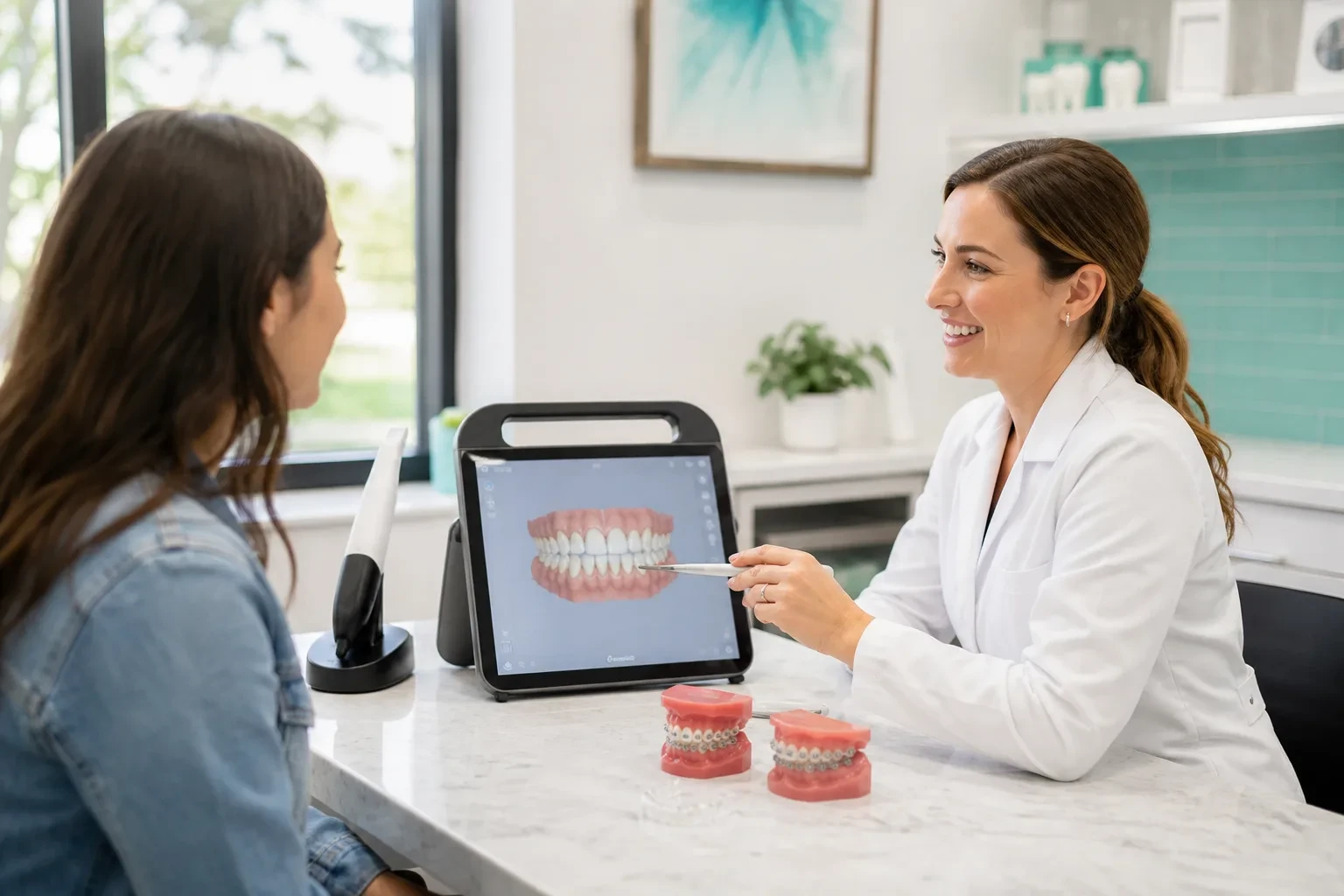
Orthodontics: Complete Guide to Braces, Aligners & Treatment (2026).
Complete orthodontics guide for 2026: braces, clear aligners, costs, treatment timelines, and how to choose a qualified orthodontist.

What Is Orthodontics?
Orthodontics is the dental specialty focused on diagnosing, preventing, and correcting misaligned teeth and jaws. Modern orthodontists use braces, clear aligners, retainers, and a growing toolkit of digital and surgical techniques to create healthy bites and confident smiles in patients of every age.
An orthodontist is a dentist who has completed 2–3 additional years of specialized residency after dental school, focused entirely on tooth movement, jaw growth, and bite mechanics. While general dentists can perform some orthodontic work, complex cases — severe crowding, jaw discrepancies, impacted teeth, surgical orthodontics — are best handled by a board-certified orthodontist with deep specialty training.
The American Association of Orthodontists estimates that more than 4 million Americans are in active orthodontic treatment at any given time, with roughly 25% of those being adults — a share that has grown dramatically over the last decade thanks to clear aligners and other discreet treatment options. Treatment isn’t just cosmetic: properly aligned teeth are easier to clean, distribute biting forces evenly, reduce wear on enamel, and can resolve speech problems and jaw pain.
This guide covers every major orthodontic treatment in 2026, real cost ranges, what to expect at every age, technology that’s transformed the field, and how to choose a qualified orthodontist for your situation — whether you’re considering treatment for yourself, your teenager, or your child.

Common Orthodontic Treatments
From the classic metal braces that have worked for generations to nearly-invisible 3D-printed aligners refreshed every two weeks, today’s orthodontic toolkit offers a solution for nearly every alignment problem and every lifestyle preference.
Traditional Metal Braces
Stainless steel brackets bonded to teeth, connected by archwires. The most affordable and time-tested option. Modern brackets are smaller and more comfortable than ever. Treatment: 18–36 months.
$3,000–$7,000
Clear Aligners
Invisalign, ClearCorrect, Spark, and others. Virtually invisible removable aligners worn 22 hours per day, changed every 1–2 weeks. Best for mild-to-moderate cases. Treatment: 6–24 months.
$3,000–$8,000
Ceramic Braces
Tooth-colored brackets that blend with natural enamel. Less visible than metal but slightly more fragile and slightly more expensive. Treatment timeline similar to metal braces.
$4,000–$8,500
Lingual Braces
Custom brackets bonded to the BACK of teeth — completely invisible from the front. Most premium option. Adjustment period for speech and tongue. Treatment: 18–36 months.
$8,000–$13,000
Self-Ligating Braces
Brackets with built-in clips holding the wire — no rubber band ligatures needed. Often advertised as faster, though research is mixed. Available in metal or ceramic versions.
$3,500–$8,000
Palatal Expanders
Custom appliance that widens the upper jaw to create space and correct crossbites. Used mostly in children whose palate hasn’t fused. Often a precursor to braces.
$2,000–$3,500
Retainers
Worn after active treatment to maintain results. Three main types: Hawley (wire + acrylic), clear retainers (Essix, Vivera), and bonded permanent wire. Lifetime essentials.
$150–$500 per set
Functional Appliances
Herbst, MARA, Twin Block and similar appliances guide jaw growth in adolescents with skeletal mismatches between upper and lower jaws. Often used before braces.
$1,500–$4,500
Headgear
External appliance occasionally used in growing children for severe overbites or crowding. Worn primarily at night. Less common today thanks to better alternatives.
$2,500–$3,500
Orthognathic Surgery
Jaw surgery combined with orthodontics for severe skeletal discrepancies that can’t be corrected with teeth alone. Performed by oral surgeon. Often medically necessary.
$20,000–$45,000+
Children, Teens, and Adults: When to Start
Orthodontic treatment timing varies dramatically by age, and the right approach depends on developmental stage, severity of the issue, and whether jaw growth is still happening.
Children (Age 7-10)
The AAO recommends a first orthodontic evaluation by age 7. Early intervention — called Phase 1 treatment — addresses crossbites, severe crowding, thumb-sucking damage, and jaw growth issues while bones are still moldable. Often involves expanders or partial braces.
Teens (Age 11-15)
The traditional optimal window for orthodontics. Permanent teeth are mostly in, jaw growth is still happening, and tissues respond well to tooth movement. Treatment typically runs 18–30 months. Compliance with appliances is the key variable.
Adults (Age 16+)
One-quarter of orthodontic patients are now adults. Treatment works at any age — teeth move via the same biological process throughout life. Differences: longer treatment time (no jaw growth to leverage), higher rates of gum recession or bone loss to consider, and often discreet aligners preferred.
Real-World Cost Breakdown
What affects the cost
Five factors drive orthodontic costs, often producing 2–3x variation for the same patient across different practices:
$Complexity of the case. A mild crowding case takes less time and fewer appointments than full bite correction with extractions or surgery.
$Type of appliance. Metal braces are cheapest. Ceramic and self-ligating cost more. Lingual braces and premium aligners are 2–3x the price of traditional braces.
$Treatment duration. Longer treatment means more chair time, more wire changes, more aligner sets. Practices typically price comprehensive cases as a flat fee, but mid-treatment changes can affect cost.
$Geography. Treatment in major metros runs 30–60% higher than mid-sized cities for identical work.
$Specialist vs. general dentist. Board-certified orthodontists typically charge 20–40% more than general dentists offering Invisalign — but bring substantially more specialty training and experience.
Insurance, payment plans, and financing
Unlike most cosmetic dentistry, orthodontics is widely covered by dental insurance — particularly for patients under 18. Typical orthodontic insurance benefits cover 50% of treatment up to a lifetime maximum (commonly $1,000–$3,000 per patient). Adults frequently have orthodontic coverage but at lower percentages and lower lifetime caps.
Most orthodontic practices offer in-house monthly payment plans that spread treatment cost across the treatment duration with no or low interest. Third-party financing through CareCredit and similar services is also widely accepted. Dental schools often provide treatment at 50–70% off market rates with supervised residents.
Choosing Treatment by Concern
Different concerns lead to different best-fit treatments. Here’s how to think about your priorities.
I Want Invisible Treatment
Clear aligners (Invisalign, Spark) for mild-to-moderate cases. Lingual braces for complex cases when invisibility is critical.
I Have Severe Misalignment
Traditional braces (metal or ceramic). Better tooth control than aligners for severe rotation, impaction, and complex movements.
I Want Fastest Treatment
Self-ligating braces with accelerated devices like Propel or AcceleDent. Limited-objective treatment for cosmetic-only correction in 6-12 months.
I Have a Bite Problem
Overbites, underbites, crossbites need traditional braces or extensive aligner treatment. Severe cases may need jaw surgery alongside braces.
I’m Budget-Conscious
Traditional metal braces remain the most affordable option. Dental school clinics offer additional savings. Avoid direct-to-consumer aligners for any but the mildest cases.
My Child Needs Treatment
First evaluation at age 7. Phase 1 treatment (expanders, partial braces) at 7-10 if needed. Phase 2 (full braces or aligners) at 11-15.

Treatment Timeline
Comprehensive orthodontic treatment typically runs 18 to 30 months, though the exact timeline depends on case complexity, treatment type, patient age, and most importantly, compliance with the prescribed wear schedule and appointments.
Mild cases (6–12 months): Limited objective treatment for one or two specific issues — cosmetic-only correction, single-tooth rotation, or closing a small gap. Often achievable with short-course aligners.
Moderate cases (12–18 months): The typical comprehensive case — moderate crowding, mild bite issues, no extractions needed. Most clear aligner cases fall in this range when treated by a skilled orthodontist.
Complex cases (18–36 months): Severe crowding requiring extractions, significant bite correction, impacted teeth needing exposure, or surgical orthodontics. Traditional braces almost always required.
Retention phase (lifetime): The often-overlooked final phase. Teeth want to drift back to their original positions; retainers prevent this. Modern retention typically involves a bonded wire behind the front teeth plus clear retainers worn at night, both maintained indefinitely.
Are You a Good Candidate?
Orthodontic treatment works for most patients at any age. The factors below determine whether treatment will succeed and produce stable results.
✓Healthy gums. Active gum disease must be treated and stabilized before orthodontic treatment begins. Moving teeth through inflamed tissue accelerates bone loss.
✓Adequate bone support. Severe bone loss limits how far teeth can be moved safely. Adults with periodontal history may need extra evaluation.
✓Realistic timeline expectations. Comprehensive treatment takes 18+ months on average. Anyone promising 6-month complete correction for a complex case is overselling.
✓Compliance commitment. Treatment success depends almost entirely on wearing appliances as instructed. Clear aligners require 22 hours daily wear — less than that, and treatment fails.
✓Good oral hygiene. Braces and aligners create more places for plaque to hide. Patients who don’t brush and floss diligently develop white spots, decay, and gum problems during treatment.
✓No untreated decay. Cavities must be filled before treatment. Decay under brackets is hard to detect and easy to miss.
✓Lifetime retainer willingness. Teeth shift forever. The only way to maintain results is permanent retention. Anyone unwilling to wear retainers indefinitely should expect relapse.

What to Expect: The Orthodontic Process
Whether you’re getting braces or clear aligners, orthodontic treatment follows the same six-phase structure. The total elapsed time runs from initial consultation through the end of active treatment, with retention continuing for life.
Consultation
Initial exam, discussion of goals, preliminary treatment options, and cost estimate. Usually 30–60 minutes. Often free or low-cost.
Records
Comprehensive X-rays (panoramic, cephalometric), intraoral 3D scan, photos, and bite registration. Used to create the precise treatment plan.
Treatment Plan
Detailed presentation of recommended treatment, expected timeline, total cost, financing options, and any preparation needed (extractions, fillings).
Appliance Placement
Brackets bonded (60–90 min) or first set of aligners delivered with attachments bonded. Initial soreness 3–5 days. Soft foods recommended.
Active Treatment
Adjustments every 4–8 weeks for braces. New aligner trays every 1–2 weeks. Continues until target alignment is achieved (18–30 months typical).
Retention
Appliances removed, retainers delivered. Initially worn full-time (3–6 months), then nighttime-only indefinitely. Periodic check-ins for first 2 years.

Orthodontic Technology in 2026
The technology behind orthodontic treatment has transformed dramatically over the last decade. Today’s leading practices use digital workflows that improve accuracy, comfort, and predictability at every stage.
Intraoral Scanners
3D scans replace messy putty impressions. More accurate, more comfortable, instantly viewable. iTero, Trios, and Medit scanners are now standard.
AI Treatment Planning
Software simulates tooth movement, predicts outcomes, and helps orthodontists optimize the treatment plan before committing.
In-Office 3D Printing
Many practices now print their own aligners, retainers, and surgical guides in-office — lower cost, faster turnaround, more iteration.
Accelerated Devices
Vibration devices (AcceleDent) and micro-osteoperforation (Propel) claim to speed treatment 30–50%. Evidence is mixed but accumulating.
Remote Monitoring
Apps like Dental Monitoring use smartphone scans every 1–2 weeks, reducing in-office visits by 30–50% during clear aligner treatment.
Self-Ligating Brackets
Built-in clips hold the archwire without elastic ligatures. Less friction, fewer adjustments needed. Damon, In-Ovation, and SmartClip are popular brands.
Risks and Important Considerations
Orthodontic treatment is overwhelmingly safe with low complication rates, but every patient should understand the potential risks before starting.
Root Resorption
A small percentage of patients experience minor shortening of tooth roots during treatment. Usually mild and not clinically significant, but occasionally affects long-term tooth stability. Periodic X-rays during treatment monitor for it.
Decalcification & White Spots
Inadequate brushing around brackets causes permanent white spots from enamel demineralization. Aggressive hygiene during treatment prevents this almost entirely.
Relapse Without Retention
Teeth will shift back if retainers aren’t worn. Most relapse happens in the first 2 years post-treatment. Bonded retainers behind the front teeth are the most reliable long-term solution.
Treatment Time Extensions
Cases that don’t move as planned, broken brackets requiring repair visits, missed appointments, and poor aligner wear all extend treatment time. Compliance is the largest single variable.
How to Choose an Orthodontist
Specialist training matters in orthodontics. Look for these signals when evaluating providers:
Board Certification
American Board of Orthodontics (ABO) certification requires written and clinical examinations. Diplomate status (DABO) signals top-tier specialty training.
Specialist Training
Confirm 2–3 years of accredited orthodontic residency after dental school. Some general dentists offer orthodontics, but specialists handle complex cases better.
Case Experience
Ask how many cases similar to yours they’ve completed. Adult treatment, surgical orthodontics, and complex cases benefit from specialized experience.
Technology Used
Modern practices use 3D scanners, digital treatment planning, and in-office printing. Practices still using putty impressions are noticeably behind.
Multiple Treatment Options
A good orthodontist offers braces, clear aligners, and specialty appliances and recommends the best option for your case — not just what they prefer to provide.
Transparent Pricing
Comprehensive treatment is typically priced as a flat fee. Beware of surprise add-on charges. The contract should include records, treatment, retainers, and post-treatment visits.
Patient Reviews
Read Google, Yelp, and Healthgrades. Look for mentions of communication style, wait times, after-hours emergency care, and treatment satisfaction.
Office Location
Treatment requires 15–30 in-person visits over 2 years. Choose an office reasonable to reach from work, school, or home — convenience affects compliance.
Maintaining Results After Treatment
Active orthodontic treatment ends. Retention is forever. The single biggest cause of disappointment with orthodontic results is retainer non-compliance after treatment.
Hawley Retainers
Classic wire-and-acrylic removable retainer. Adjustable, durable, lasts 10+ years. Most visible of the retainer types. Standard at many practices.
Clear Retainers
Essix, Vivera, and similar. Look like clear aligners. Invisible but wear out faster (1–2 years typical) and easier to lose.
Bonded Retainers
Thin wire bonded permanently behind the front 4–6 teeth. Invisible, no compliance required. The gold standard for long-term retention. Lasts 5–15+ years.
Wear Schedule
Full-time wear (22+ hours) for the first 3–6 months. Nighttime-only thereafter, indefinitely. Skip nights and teeth shift.
Replacement Cost
Removable retainers wear out and get lost. Budget $150–$500 per replacement set every 1–3 years. Vivera offers multi-set discounts.
Periodic Check-Ins
Most orthodontists include 2 years of retention check-ins in treatment cost. Annual visits thereafter ensure retainers still fit and teeth haven’t shifted.
Frequently Asked Questions
How long does orthodontic treatment take?
Comprehensive treatment averages 18–30 months. Mild cosmetic-only cases finish in 6–12 months. Complex cases involving extractions or jaw surgery can take 24–36 months. Retention then continues for life. Treatment time depends on case complexity, patient age, appliance type, and most importantly compliance with wear schedules and appointments.
How much does orthodontic treatment cost?
Comprehensive treatment ranges from $3,000 for limited-objective work to $13,000 for premium lingual braces or complex Invisalign cases. Surgical orthodontics adds $20,000–$45,000+ for jaw surgery. Costs vary significantly by geography, specialist vs. general dentist, appliance type, and case complexity.
Are clear aligners as effective as braces?
For mild-to-moderate cases, modern clear aligners produce results comparable to braces. For severe crowding, complex bite problems, large gaps, or significant tooth rotation, braces still offer better control. The best orthodontists match the appliance to the case rather than forcing one approach.
Can adults get braces?
Yes — one in four orthodontic patients is now an adult. Treatment works at any age because tooth movement uses the same biological process throughout life. Adult cases typically take longer than teen cases (no jaw growth to leverage) and require closer monitoring of gum and bone health.
Does dental insurance cover orthodontics?
Most plans include some orthodontic benefit, typically 50% of treatment cost up to a lifetime maximum of $1,000–$3,000 per patient. Coverage is most common for children and teens. Adult orthodontic coverage exists but is less universal. Always verify your specific benefit before treatment.
Is orthodontic treatment painful?
Initial discomfort after appliance placement and after each adjustment lasts 3–7 days. Most patients describe it as soreness or tightness rather than sharp pain. Soft foods and over-the-counter pain relievers help. Severe pain is unusual and warrants follow-up.
What’s the difference between an orthodontist and a general dentist offering Invisalign?
An orthodontist completes 2–3 years of specialty residency after dental school focused entirely on tooth movement and jaw mechanics. A general dentist offering Invisalign typically completes a weekend or week-long certification course. For mild cases, general dentists can produce good results. For complex cases, the specialist’s deeper training matters significantly.
When should my child see an orthodontist?
The American Association of Orthodontists recommends a first orthodontic evaluation by age 7. Most children won’t need treatment at that age, but the evaluation identifies issues (crossbites, severe crowding, thumb-sucking damage, jaw growth concerns) that benefit from early intervention while bones are still moldable.
What happens if I don’t wear my retainer?
Teeth shift back toward their original positions. The biological forces that hold teeth in place don’t care about the months you spent in treatment. Most relapse occurs in the first two years post-treatment, but teeth continue subtle movement throughout life. Lifetime retainer wear is the only way to maintain results.
Can I eat normally with braces or aligners?
With braces: avoid sticky, hard, and chewy foods (caramel, popcorn kernels, ice, hard candy, raw apples) that can break brackets or bend wires. With aligners: remove them before eating or drinking anything except water. Eating with aligners in causes staining, breakage, and trapped food against teeth.
Find a Orthodontist Near You
Browse vetted orthodontists in cities across the United States. Each city directory lists the top-rated providers, recent patient reviews, and contact information.
AK
CA
CT
DC
FL
HI
IA
MD
MN
MS
NJ
NM
RI
SD
TX
WI
Find Top-Rated orthodontists Near You
Browse our curated, locally-reviewed directories of the best orthodontists in these cities: